
interval type-2 fuzzy predictive modelling for a high shear granulation process
Wafa’ H. Alalaween1, Mahdi Mahfouf1 and Agba D. Salman2
1
Department of Automatic Control and Systems Engineering, University of
Sheffield, UK
2 Department of Chemical and Biological Engineering, University of
Sheffield, UK
Email: whalalaween1@sheffield.ac.uk
Nowadays, there is a strong need for a further step to be taken towards the development of a cost-effective product that meets the stringent regulations that are being imposed on most industries. Such a step is very important but represents a non-trivial task, particularly for the pharmaceutical industry and those industries where, for instance granulation is defined as being a unit operation of the production process; this being due to the complex nature of the granulation process itself. Consequently, developing a fast, more accurate, transparent and cost-effective predictive model is a target that researchers in both industry and academia strive to achieve. Moreover in the pharmaceutical industry, such a target, if it is successfully achieved, may significantly decrease the time required for new drug development. Since the granulation process is considered to be the unit operation that determines the properties of the final drug, various approaches have hitherto been utilized to model this process such as population balance or neural networks based models [1-2]. However, these modelling approaches cannot effectively deal with the uncertainties present in both the inputs and the outputs of the granulation process systematically. Such uncertainties may be due to measurement errors or constraints, or simply to the heterogeneous distribution of both porosity and binder content during the granulation process. In this research, a type-2 fuzzy modelling paradigm has been implemented to predict the properties of the granules produced by a high shear granulation process and also to absorb any uncertainties that surround the process. This choice was motivated by the fact that fuzzy logic can deal with uncertainties more naturally and is considered to be a universal approximator. In addition, such a model has been utilized to extract meaningful information to describe the process linguistically in a simple way that can be understood by users. In order to take account of any unmodelled stochastic behaviour of the process, and also to improve the prediction performance, a Gaussian mixture model has been used. Experimental results show that the proposed predictive model was successful in predicting the properties of the granules accurately, as shown in Figure 1, with the added advantage of the modelling framework being interpretable.
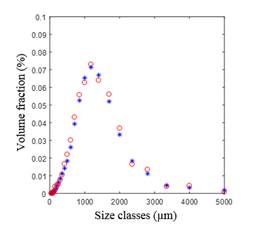
Figure 1. The modelling framework: The predicted (o) and the experimental (*) size distribution (using impeller type II, speed=6000rpm, L/S ratio (w/w)=15% and granulation time=15min).
References
[1] C. Sanders, A. Willemse, A. Salman, M. Hounslow, Development of a predictive agglomeration model, Powder Technology, 138 (2003) 18-24.
[2] W.H. AlAlaween, M. Mahfouf, A.D. Salman, Predictive modelling of the granulation process using a systems-engineering approach, Powder Technology, 302 (2016) 265–274.
See more of this Group/Topical: Particle Technology Forum