
Development of an Inline Measurement Tool for Particle Size and –Shape Analysis during the Granulation Process
Maria Niesing, Technical University Dortmund
Dominik Weis, Technical University Kaiserslautern
Sergiy Antonyuk, Technical University Kaiserslautern
Markus Thommes, Technical University Dortmund
Inline measurement tools provide an efficient way of monitoring industrial processes. Generated data during the process can prove to be valuable for process optimization, and processing times can be shortened by implementing endpoint-detection. Especially for pharmaceutical applications, close process surveillance is necessary to ensure quality by design. Therefore, several process analytical tools for particle size measurement of granules have been developed. However, the quality of a granule is not only determined by the particle size, but also by the particle shape. With most commercially available tools for inline particle size measurement, no information about the particle shape is gained[1].
A common technique to gain uniform, spherical granules for pharmaceutical use is extrusion/spheronisation. Here, extrudate strands are generated by wet extrusion. The wet extrudates are then rounded in a spheronizer, a machine which consists of a cylindrical jacket and a rotating plate at the bottom. Through breakage, attrition and agglomeration, the long extrudate strands are formed into spherical particles[2]. Previous works show that so far, no commercially available process analytical tool can provide inline particle size and shape measurement of moving particles in a spheronizer. The aim of this study is the development of a method for the inline particle size and shape determination for the spheronization process. The measurement is facilitated by the round shape of the particles and the narrow size- and shape distribution[3].
An optical method was preferred to get information about the particle shape. A script for image analysis was written in Python 2.7, using the libraries Pillow 3.2.0, Scipy 0.17.1, Numpy 1.11.1, Scikit-image 0.12.3 and Mahotas 1.4.1. The equivalent diameter was used for size determination of each particle. For the shape description, the maximum feret diameter, its perpendicular feret diameter and the minimum feret diameter was calculated. The aspect ratio, calculated by dividing the maximum feret diameter by the minimum feret diameter, was used to describe the sphericity. The calculation of the aspect ratio by the maximum feret diameter and its perpendicular feret diameter is also possible.
To validate the correct function of the script, granules of different shapes and sizes were generated by extrusion/spheronization of a powder mixture (20% MCC, 80% Lactose) with different amounts of water, which served as granulation fluid. Images of the dried particles where taken under a microscope on dark background. These images were analyzed with the python script and with the open source software ImageJ.
The inline measurement was achieved by placing a High-Speed-Camera (HighSpeedStar 3G, LaVision, Göttingen, Germany) in front of the glass cylinder of a spheronizer(Ø 120 mm). The friction plate was rotating with a peripheral speed of 2 m/s. To ensure that no particle was contained in consecutive images, the Camera took 60 images per second, each with an exposure time of 1/4000 s., LED lights were placed beside, over and under the spheronizer, illuminating the particles from a sharp angle and enhancing particle-background contrast Granules from the same batches that were measured under the microscope were now measured inline in the spheronizer.
Comparison of the results from the python script and ImageJ showed that the equivalent diameter, the maximum feret diameter and the minimum feret diameters did not differ between the two methods. ImageJ is by default not able to detect the feret diameter that lies orthogonal to the maximum diameter. The python script was able to analyze a picture of 2592 x 1944 pixels in less than six seconds on a standard office computer, while the semiautomatic analysis with ImageJ took about two minutes per image.
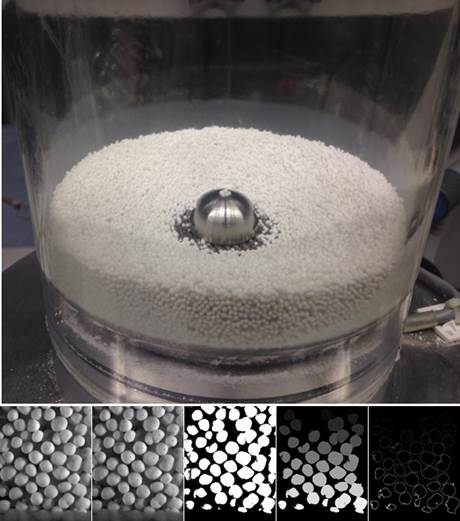 The equivalent diameter measured
inline was systematically smaller than the equivalent diameter that was
obtained by the offline measurement. This was expected, since the inline
measurement technique tends to ignore particle areas that are shadowed by other
particles. Therefore, the outer edges of a particle are often cut off. The
amount of deviation between the inline and offline measurement depends on the
particle size and shape. Since the minimum feret
diameter is affected stronger than the maximum feret
diameter, the calculated aspect ratio is too high. However, the inline
measurement still gives valuable information about trends in the change of
particle size and shape.
The results show that inline measurement of particle size and shape during extrusion/spheronization is possible. However, improvement concerning the measurement of the particle shape is needed.
1. A.F.T. Silva, A. Burggraeve, Q. Denon, P.V.d. Meeren, N. Sandler, T.V.D. Kerkhof, M. Hellings, C. Vervaet, J.P. Remone, J.A. Lopes, and T.D. Beer, Particle sizing measurements in pharmaceutical applications: Comparison of in-process methods versus off-line methods. European Journal of Pharmaceutics and Biopharmaceutics, 2013. 85(3): p. 12.
2. M.D. Köster, Spheronization Process - Particle Kinematics and Pellet Formation Mechanisms, in Institut für pharmazeutische Technologie und Biopharmazie. 2012, HHU Düsseldorf. p. 108.
3. L. Hellen and J. Yliruusi, Process variables of instant granulator and spheroniser: III. Shape and shape distributions of pellets International Journal of Pharmaceutics, 1993. 96.
See more of this Group/Topical: Particle Technology Forum