
The main purpose of this presentation is to demonstrate that contrary to the popular belief that ample land area is available to install photovoltaic modules, in an economy mainly supported by solar energy, there will be severe land availability constraints in many regions of the world—including many states in the USA. This will inevitably lead to competition for land between food and energy [1]. We therefore propose several innovative PV systems that will allow for the co-production of food and energy from the same unit area of farmland thereby allowing local energy needs to be met by local supply of photons. This allows us to overcome feedstock (land) and transport (long-distance transmission) limitations for electrical generation that would otherwise be difficult to overcome in a solar economy.
A recent study by MacKay showed that the energy consumption per unit area in densely populated countries such as the UK, Germany, Republic of Korea, and Japan is approaching the energy generation per unit area of photovoltaic farms [2]. This suggests that a transition to a solar powered economy in these nations would require deployment of solar on a large fraction of the nation’s total land area, which will directly compete with land requirements for other needs (e.g. agriculture). Many other countries, including the United States are also trending toward this scenario [2]. A recent study by National Renewable Energy Laboratories confirms the large land area requirements of solar farms [3].
Using the available data on current U.S. energy consumption and land availability [4]-[5], we have estimated that as many as 31 states may be unable to meet their needs without importing energy long distances from other states or offshore. This scenario arises because much of the open land in the U.S. is devoted to cropland (21.5%), pasture land (32.3%), and forest land (30.4%). Only 3.6% of the land falls in the category of miscellaneous/other use land [5].
As it should remain a priority to preserve our native forest and wildlife areas, one of the greatest opportunities for increasing the availability of land for solar energy generation is over farmland. These land areas are often easily accessed and surround population centers. However, if PV is to be successful deployed over farmland, novel systems will need to be designed that do not negatively impact crop production. As most photosynthetic activity requires only the visible portion of the spectrum (400-750 nm), these wavelengths can be allowed to past through to plants while the IR portion of the spectrum is harvested as electricity. It is also clear that plants can go relatively extended periods of time without solar irradiance (night) and survive extended periods of reduced lighting (cloudy days) without significant impact to crop production so it may be possible to harvest a portion of the visible portion as well.
Figure 1 shows several possible configurations for harvesting solar energy over farmland. Fig. 1 (a)-(b) are systems that could operate optimally using current industrially-proven solar absorbers (e.g. silicon). Fig. 1 (c)-(f) shows systems for which light splitting would result in even higher performance by optimizing the band gap of the absorber for the portion of the spectrum it is absorbing. Fig. 1(a) is the simplest case in which south-facing PV modules are altered such that every other cell is left open or replaced with a light diffuser. In this system crops never experience shading for very long as the shadow will be constantly moving underneath the panel. Fig. 1(b) is the case in which single- or dual-axis tracking panels are used. Again, the shadow will move throughout the day. In the event that crops cannot tolerate extended periods of shade, these panels can also be patterned and be made twice the size to decrease the time intervals of shading, though the total time each plant would spend in the shade over the course of the day would be the same.
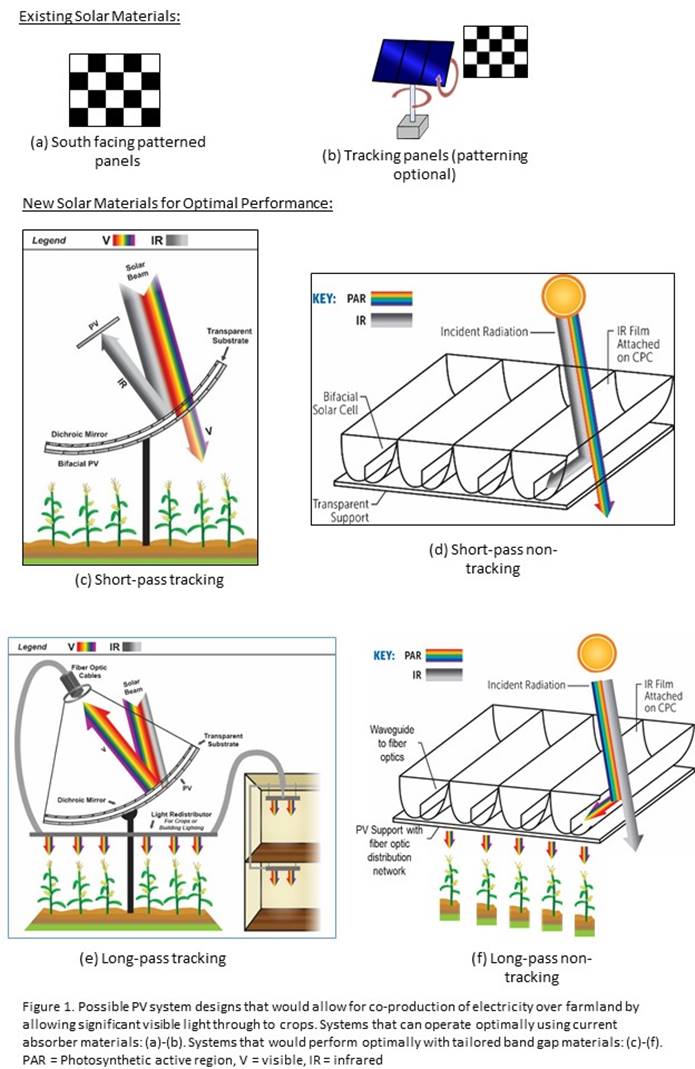
Fig. 1(c)-(f) are systems based on industrially available dichroic mirrors that split the spectrum [6]-[7]. These offer the advantage of concentrating the light for higher efficiencies. As a downside, diffuse portions of the spectrum may not be harvested efficiently. In Fig. 1(c), a tracking parabolic trough system is used in which the IR portion of the spectrum is reflected to a PV cell of appropriate band gap while the visible light passes through. As an option, a thin bifacial PV cells may be placed at the back (or a pattern thereof) to harvest a portion of the visible light and light scattered back from the crops. In Fig. 1(d), the system is non-tracking for mechanical simplicity and directs much of the IR spectrum to bifacial PV cells of appropriate band gap. During non-growing seasons, PV panels could be inserted in place of the transparent support. Fig. 1(e) depicts a tracking, long-pass system in which the visible light is concentrated and collected in fiber optic cables and then redistributed to plants underneath (and potentially other uses such as lighting. Fig. 1(f) depicts a non-tracking, long-pass system in which visible light is again collected in fiber optic cables and then redistributed to plants underneath, while the IR passes through to be collected on PV of appropriate band gap underneath. Promising preliminary calculations have been completed and are on-going to determine how much power can be produced and the optimal band gaps for each system.
The choice of which system to use will depend on how the crops respond to different shading characteristics and how much light deprivation and which portions of the spectrum they can tolerate being deprived of. It will also depend on the relative percentage of diffuse to direct light in a geographic location as the systems in Fig. 1(a)-(b) are better suited for areas with more diffuse light. We explore these options and make some general conclusions on system selection.
References
[1] Solar Projects Sow Tension, Wall Street Journal, Wall Str. J. (2017) A3.
[2] D.J.C. MacKay, Solar energy in the context of energy use, energy transportation and energy storage., Philos. Trans. A. Math. Phys. Eng. Sci. 371 (2013) 20110431. doi:10.1098/rsta.2011.0431.
[3] S. Ong, C. Campbell, P. Denholm, R. Margolis, G. Heath, Land-Use Requirements for Solar Power Plants in the United States - Technical Report NREL/TP-6A20-56290, 2013.
[4] State Profiles and Energy Estimates, (n.d.). http://www.eia.gov/state/.
[5] Major Land Uses, (n.d.). https://www.ers.usda.gov/data-products/major-land-uses/.
[6] T. Ulavi, T. Hebrink, J.H. Davidson, Analysis of a hybrid solar window for building integration, Sol. Energy. 105 (2014) 290–302. doi:10.1016/j.solener.2014.03.006.
[7] E. Gençer, C. Miskin, X. Sun, M.R. Khan, P. Bermel, M.A. Alam, R. Agrawal, Directing solar photons to sustainably meet food, energy, and water needs, Sci. Rep. (2017).
See more of this Group/Topical: Sustainable Engineering Forum