
Generic pharmaceutical industry has to operate in tight timelines of product development and scale up from lab to plant. Getting it right the first time demands detailed product & process understanding and implementing appropriate mechanistic modelling and Quality-by-design (QbD) approaches in the product life cycle, to minimize downstream risks. This work provides example cases of such efforts in topical dosage products.
Topical products are typically in the form of either emulsions, gels, thick suspensions or even simple solutions. The efficacy of such products is determined by characteristics like rheology and morphology (how the drug is dispersed). Defining, and scaling up the right manufacturing process with a given set of ingredients, to achieve the right product characteristics presents as a challenge to the process engineer. Figure 1 shows a simplified process flow diagram for the manufacture of topical product using an inline mixer while figure 2 captures the relevant critical materials attributes (CMAs) and critical process parameters (CPPs) that impact the critical quality attributes (CQAs) of semi-solid dosage form. But in practical sense, these properties are inter-linked (Figure 3).
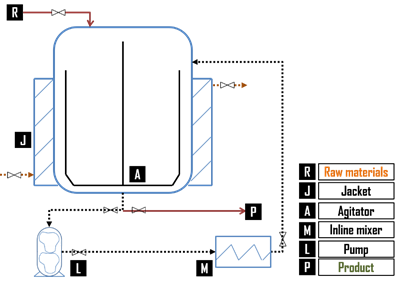
Figure 1 – Process flow diagram
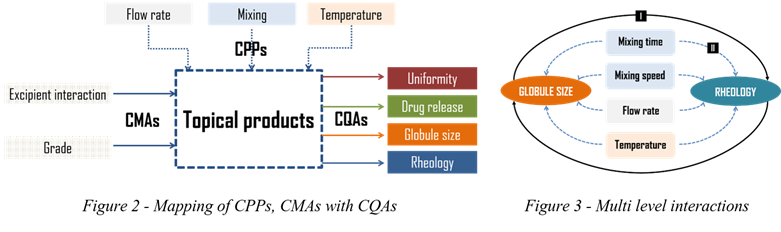
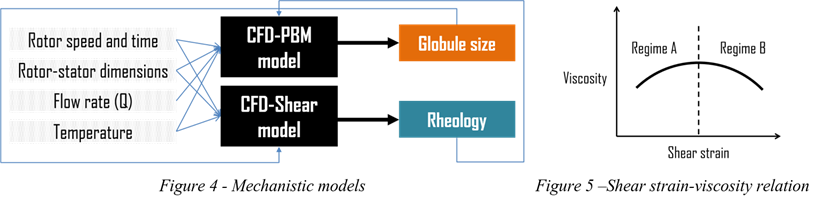
For example, the non-Newtonian rheology varies not only with CPPs and CMAs but also is an implicit function of globule size (CQA). Hence, this calls for various mechanistic models, to help predict the product behaviour. This paper focusses on such models (Figure 4) obtained from computational fluid dynamics (CFD) coupled with population balance modelling (PBM) and constitutive models (like shear, energy density). Custom lab scale experimentation provides the required model parameters. Such efforts are leveraged to facilitate scale-up of the products from the lab to plant. In a special case of the use of high shear homogenisers (HSHs) for the manufacture of thick emulsions/ gels, this work presents some findings on (i) scale-up algorithm for HSH using shear strain, a novel scale-up parameter for estimating mixing parameters, (ii) non-linear relationship (Figure 5) between viscosity and shear imparted into the system, (iii) effect of hold time on rheology of product.
Specific examples of how this approach enabled scale-up across 1L, 10L, 200L, 500L and 1000L scales will be discussed
See more of this Group/Topical: Pharmaceutical Discovery, Development and Manufacturing Forum