
We present a methodology to streamline tableting process development complemented by a mathematical model of disintegration and dissolution. In a state-of-the-art tableting process development the main goal is to achieve an optimal tradeoff between mechanical strength, disintegration time, friability, dissolution profile, tablet weight uniformity and any other performance variable of interest. Excluding dissolution testing, the assessment of tensile strength, disintegration time, friability and tablet weight uniformity is based on simple and fast tests which can be performed during the tablet manufacturing and the results can be promptly used for the process optimization. In contrast, the dissolution assessment is laborious, time consuming and can only be reliably performed in analytical laboratories. Therefore, taking into account the dissolution profile in the optimization loop largely increases the development cycle-time which is often not feasible at early process development stages. However, this is particularly important when formulating amorphous drug product intermediates to optimize the release rate and supersaturation maintenance which are paramount for drug performance [1].
In the proposed methodology the early assessment of dissolution profile is performed with a first principles mathematical model which takes into account intrinsic material properties such as drug diffusivity in the polymer matrix and in the dissolution media [2], the polymer swelling/erosion rate [3] and whether the API is crystalline or is in an amorphous solid dispersion. The disintegration dynamics are handled with a Population Balance Equation [4] and are coupled to the dissolution model. Whenever direct assessment of intrinsic material properties is not possible, these parameters are obtained via curve-fitting the model to experimental dissolution data. The curve-fitting is performed using a particle swarm optimization algorithm, which is suitable for multivariate and multi-objective problems.
We present a case-study on the application of the methodology to the downstream process development of an amorphous solid dispersion which illustrates the advantages of complementing laboratory development with a computational tool in terms of process and drug performance without hindering the development cycle-time.
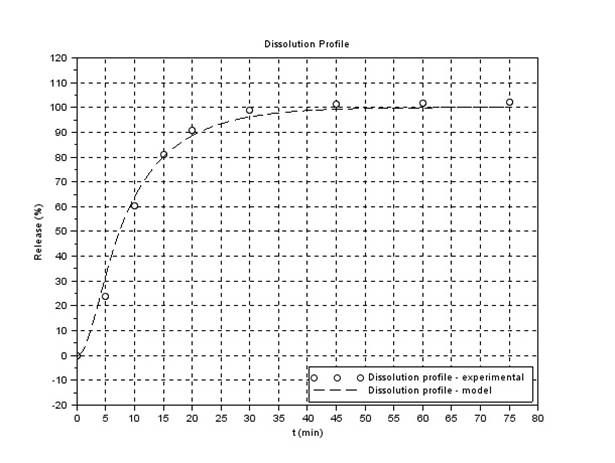
Figure 1: Dissolution profile of a tablet formulated from an amorphous solid dispersion intermediate obtained both experimentally and from the presented mathematical model.
References
[1] Henriques, J., Valente, P. & Winters, C. “Formulating Amorphous Solid Dispersions: Bridging Particle Engineering and Formulation”, American Pharmaceutical Review, Nov/Dec. 2016.
[2] Wang, Y., Abrahamsson, B., Lindfors, L. & Brasseur, J.G. “Comparison and Analysis of Theoretical Models for Diffusion-Controlled Dissolution”, Mol. Pharmaceutics, 9, 1052-1066, 2012.
[3] Siepmann, J., Kranz, H., Peppas, N. A., & Bodmeier, R. “Calculation of the required size and shape of hydroxypropyl methylcellulose matrices to achieve desired drug release profiles”, Int. J. of Pharm., 201(2), 151–164, 2000.
[4] Wilson, D., Wren, S. & Reynolds G., “Linking Dissolution to Disintegration in Immediate Release
Tablets Using Image Analysis and a Population Balance Modelling Approach”, Pharm. Res., 29:198-208, 2012.
See more of this Group/Topical: Pharmaceutical Discovery, Development and Manufacturing Forum