
The processing of residual lignocellulosic biomass within the biorefinery frames impelled the use of green innovative technologies aiming at sustainable valorisation of this feedstock. The main constrain is related to the complex and recalcitrant macromolecular three-dimensional structure of biomass. The efficient and selective pre-treatment of biomass into main constituents i.e. cellulose, hemicellulose and lignin opens a possibility to produce diverse biofuels, biochemicals and biomaterials as it happens in fossil refinery. Ionic liquids (ILs) are one of the most promising solvents which offers greener solutions in biomass conversion technologies into a great variety of products.1 The present work discloses two different scenarios of lignocellulosic biomass (wheat straw) processing with ILs, where i) alkaline or ii) acidic character of ILs remark biomass fractionation and subsequent product formation.
ILs with alkaline character demonstrated ability to dissolve the entire biomass allowing fractionation of each single fraction of biomass. Such approach produced high-purity fractions of cellulose, hemicellulose and lignin and IL was recycled and reused with success confirming the economic and environmental feasibility of the proposed method.2 Besides, a fraction rich in phenolic compounds was also produced by employing polymeric resins and supercritical CO2 (scCO2) extraction. Silica C18 resin showed the highest extraction efficiency of phenolic compounds, while Amberlite XAD-7 was the most selective one. Nevertheless, a residual quantity of IL was found in the extracted samples and further purification was achieved by applying scCO2 extraction. An extract containing vanillin, tricin, syringaldehyde, p-coumaric and vanillic acids, was produced with no IL presence.3 The discussed approach is presented in Figure 1.
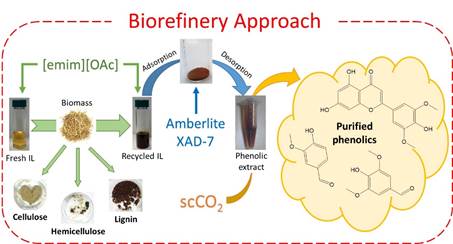
Figure 1. Biomass fractionation after pre-treatment with [emim][OAc] and further extraction and purification of phenolic compounds.
Another strategy of biomass valorisation was based on selective removal of the hemicellulose fraction of biomass solely using acidic ILs, i.e. 1-butyl-3-methylimidazolium hydrogen sulphate ([bmim][HSO4]) and 1-ethyl-3-methylimidazolium hydrogen sulphate ([emim][HSO4]). The acidity of [HSO4]-based ILs hydrolyses hemicellulose and produce pentoses or furfural leaving a solid fraction constituted by cellulose and lignin for further valorisation in the perspective of the biorefinery concept.4 The capacity of these ILs to hydrolyse and/or convert biomass into pentoses and furfural can be attained by controlling the reaction conditions, such as temperature, residence time and water content. A maximum pentose yield of 81.6 mol% was obtained after processing of wheat straw at 141 °C during 1.5 hours with [emim][HSO4]/water mixture containing 58 wt. % of water. The obtained result is for now, far the best result reported in literature for biomass processing with ILs.
The present work demonstrates the great versatility of ILs to assist biomass processing for the manufacture of a wide range of products. Particularly, the ILs chemical character governing pathways in the fractionation of biomass allowing designing specific strategies towards the production of target chemicals.
Acknowledgments
This work was supported by the Fundação para a Ciência e a Tecnologia (FCT/MEC, Portugal) through SFRH/BD/90282/2012, IF/00471/2015 grants and by BBRI - Biomass and Bioenergy Research Infrastructure (ROTEIRO/0189/2013) and the Associated Laboratory for Sustainable Chemistry−Clean Processes and Technologies−LAQV which is financed by national funds from FCT/MEC (UID/QUI/50006/2013) and co-financed by the ERDF under the PT2020 Partnership Agreement (POCI-01-0145-FEDER-007265). This work was done in the frame of COST EUBIS TD1203 action.
References
1. R. Bogel-Lukasik, Ionic Liquids in the Biorefinery Concept, RSC, Cambridge, UK, 2015.
4. A. V. Carvalho, A. M. da Costa Lopes and R. Bogel-Lukasik, RSC Adv., 2015, 5, 47153-47164.
See more of this Group/Topical: Sustainable Engineering Forum