
Spherical granules with a narrow size distribution and a regular shape are highly interesting for pharmaceutical applications. To produce such pellets, a combined extrusion and spheronization process is widely used. A spheronizer consists of a stationary cylindrical wall and a rotating disk with a structured surface. The rounding of the cylindrical extrudates is influenced by various overlapping mechanisms. An important factor affecting those mechanisms is the particle dynamics in the spheronizer, which depends on the process conditions and the pellets properties. The simulation of the particle dynamics with the Discrete Element Method (DEM) is a useful tool to get detailed information of what happens during the pellet rounding. In addition to particle kinematics and collision characteristics, other effects like segregation and mixing can be analyzed.
For the prediction of real particle interactions, the contact behavior of the simulated pharmaceutical pellets needs to be modelled with a suitable model. For this purpose, the deformation behavior was estimated experimentally in single particle uniaxial compression tests with the Texture Analyser (TA.XTplus, Stable Micro Systems, UK). The obtained force-displacement curves were used to develop a contact model which describes the particle interactions in the simulation. In the quasistatic compression tests, viscous effects cannot be investigated. Therefore additionally impact tests at different impact velocities were performed in addition to the compression tests as shown in [1] and considered in the model.
For the experiments pellets were produced with the combined extrusion and spheronization process. A mixture consisting of microcrystalline cellulose (Vivapur 102, JRS Pharma, Germany) with a mass fraction wi = 0.2 g/g and α-lactose monohydrate (Granulac 200, Meggle, Germany) with wi = 0.8 g/g was extruded (Micro 27 GL-28D, Leistritz, Germany) with water at 300 rpm. Afterwards, 450 g of the extrudates were spheronized in a lab scale spheronizer (RM300, Schlüter, Germany) with a rotational speed of the friction plate of 750 rpm for 5 minutes.
The spheronized pellets have a high moisture content of about 40%. Since the moisture has a significant impact on the deformation and breakage behavior, drying of the pellets during the compression tests must be avoided. For that reason, the compression tests were performed in a climatic chamber, where the temperature and the moisture can be controlled. During the spheronization process, the pellets undergo multiple loadings. To study the cyclic deformation behavior cyclic compression tests of pellets at different force levels and stress rates were carried out.
In our previous works [2, 3], the force-displacement curve were approximated with linear relations according to the model of Walton&Braun [4, 5]. In [6] different approaches to model plastic material behavior based on the work of Tomas and Luding can be found. In this contribution, a new contact model is presented. The force-displacement relationship during loading and reloading is still modelled using a linear function, however the unloading stage is approximated with a power law to further increase the accordance of model and experiment. Moreover, the change in stiffness for reloading because of plastic deformation and consolidation in the contact area is considered, using the flattening of the particle. The force displacement curves of the linear and the new model are shown in figure 1 with a characteristic experimental result.
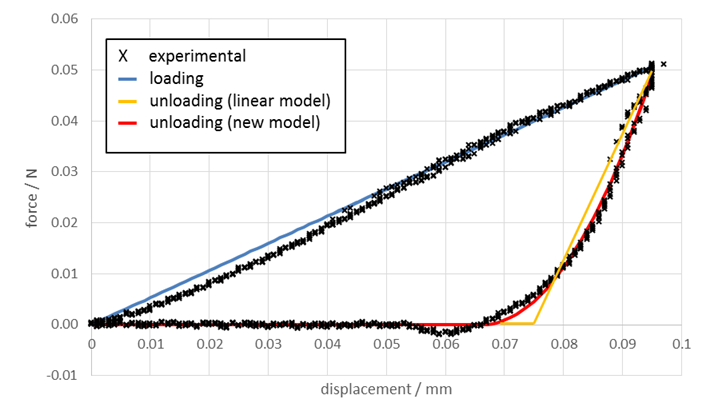
Figure 1: Force displacement curves of the linear and the new model compared with a characteristic experimental result
DEM simulations of the particle dynamics in a spheronization process were performed using the developed contact model and compared against simulations based on the linear contact model regarding computing time and deviation of the results. The collision rates and forces of the pellet interaction with other pellets and the apparatus walls were in particular focus. Distributions of the collision rates and the time averaged collision forces in the spheronizer were obtained.
References:
[1] Antonyuk, S., Heinrich, S., Tomas, J., Deen, N.G., van Buijtenen, M.S. and J.A.M. Kuipers: Energy absorption during compression and impact of dry elastic-plastic spherical granules, Granular Matter 1(12), 2010, 15-47.
[2] Weis, D., Antonyuk, S.; Thäte, D.; Thommes, M.: DEM Simulations of Particle Dynamics in a Spheronization Process to describe the Pelletization Mechanisms. IV International Conference on Particle-Based Methods, Proceedings, ISBN 978-84-944244-7-2, S. 567-578
[3] Weis, D., Antonyuk, S., Thommes M.: Manufacturing of Pharmaceutical Pellets by Spheronization - DEM Simulation of Particle Kinematics. PARTEC 2016, International Congress for Particle Technology, Proceedings
[4] Walton, I. OR, and R. L. Braun: Stress calculations for assemblies of inelastic speres in uniform shear. Acta mechanica 63(1-4), 1986, 73-86.
[5] Walton, O. R., Braun, R. L.: Viscosity, granular‐temperature, and stress calculations for shearing assemblies of inelastic, frictional disks. Journal of Rheology 30(5), 1986, 949-980.
[6] Tykhoniuka, R. et al.: Ultrafine cohesive powders: From interparticle contacts to continuum behavior. Chemical Engineering Science 62, 2007, 2843 – 2864.
See more of this Group/Topical: Particle Technology Forum