
The complexity and widely variable operating envelope of modern cyber-physical systems yields a need for advanced fault detection and isolation (FDI) algorithms. Efficient and accurate FDI tests can reduce maintenance cost, and improve system reliability and performance,1,2 which are becoming increasingly significant in the aerospace and automotive industries. Recent advances in the field of active FDI3,4 allow for better detectability and isolatability of faults by implementing advanced control logic for the Built-In Tests deploying FDI.5,6 In this presentation, we will outline a comprehensive workflow that improves FDI robustness and accuracy through an optimal selection of input settings prior to FDI test execution.
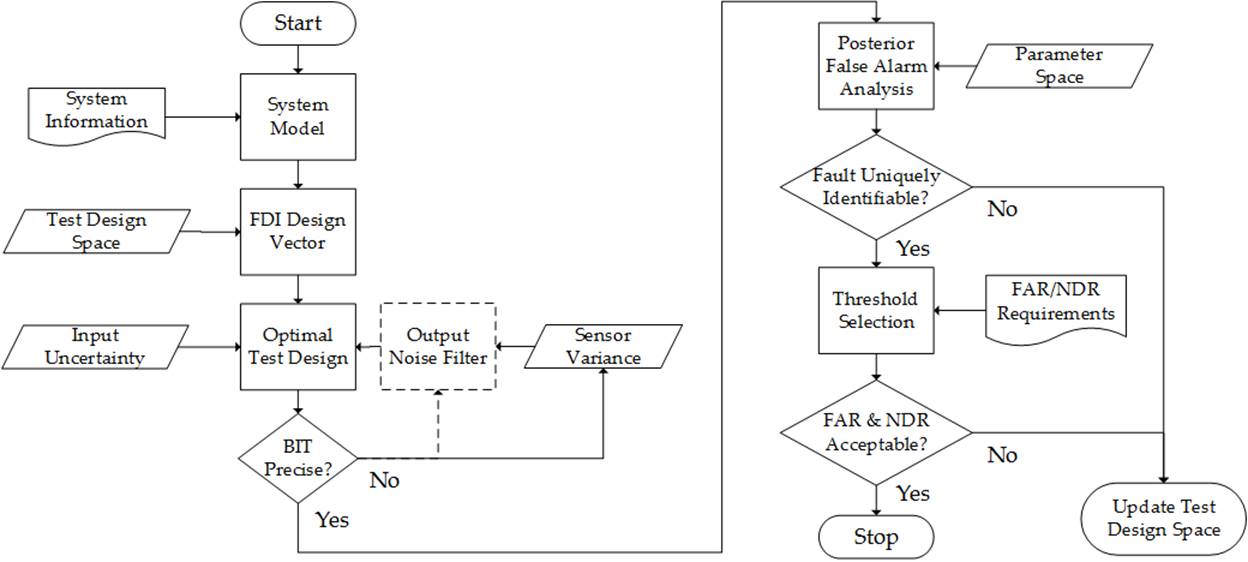
Figure 1. Outline of framework for improving active FDI test designs
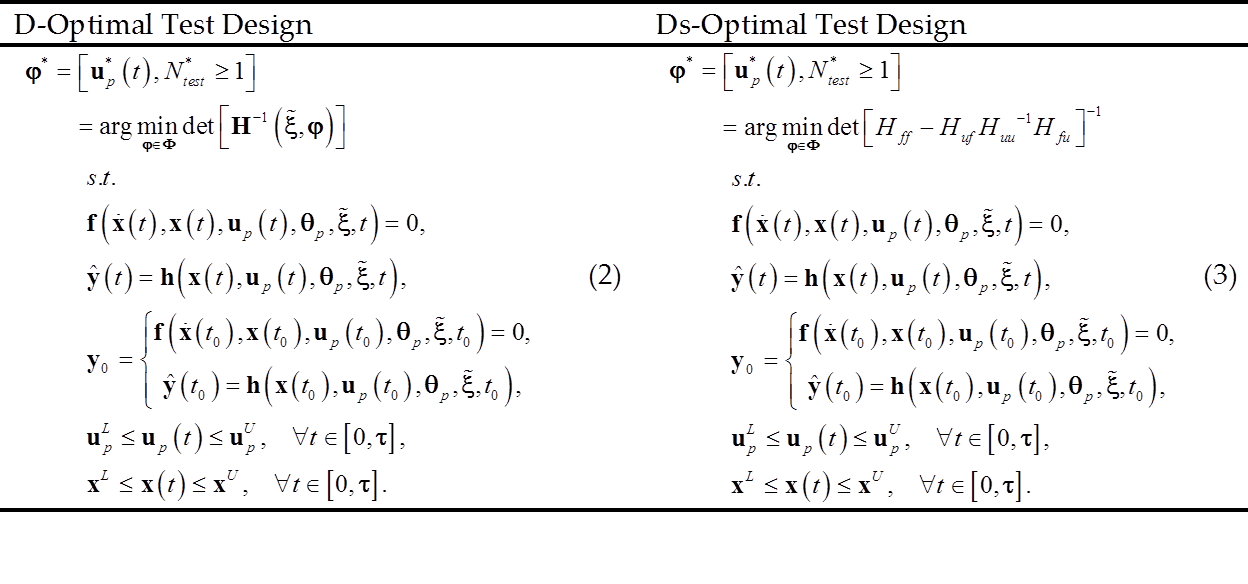
In the proposed workflow, model-based, active fault detection and isolation is accomplished by solving a set of optimization problems, constrained within the system operating space. Figure 1 presents an overview of this framework for test design selection. Models that accurately represent the system (especially the steady state and transient system responses to faults) are used to generate output forecasts with and without the anticipated fault(s) present. Modelling error and uncertainty in the form of environment variability are minimized, in terms of their impact on the FDI test. The improvement in fault identifiability is accomplished with two different optimal test design criteria, both using the output sensitivities, Qi, of i-th outputs at a predetermined number of sampling points with respect to the targeted faults and uncertainty, ξ. The first criterion designs tests satisfying D-optimality, which minimizes the correlation of all the elements in ξ.7–9 The second approach maximizes the information with respect to the faults and minimizes the impact of uncertainty, using the so-called Ds-optimality criterion.10 Sensitivities are compiled into modified formulations of the Fisher Information Matrix, Hξ, which is a function of the parameters representing faults and uncertainty in the system model and the test design vector. As shown in Eq.(1), Hξ is partitioned into submatrices corresponding to (ξ1… ξf) and (ξf+1… ξu) that contain the correlations between faults (Hff), uncertainty (Huu), and that between faults and uncertainty, (Huf , Hfu):

where σij is the estimated measurement variance between the i-th and j-th outputs. The optimal test design vector for each criterion is formulated for differential algebraic equations describing dynamic systems as shown in Eqs. (2) and (3) of Table 1.
Table 1. Mathematical formulation of the FDI test optimization for steady-state and dynamic test designs
Execution of the optimal FDI tests designed, leads to data that need to be analyzed in terms false alarm rates (FAR) and non-detection rates (NDR). First, the space of uncertain parameters and boundaries is explored to determine if similar output trajectories can be generated for faulty and fault-free systems at the chosen design of admissible inputs. The mathematical formulation of this search is based on practical identifiability of model parameters (not shown in this abstract). Thereafter, thresholds are designed to minimize the FARs and NDRs. We evaluate the residuals generated from an FDI test through a positive definite function (e.g. normalized root mean square). We iterate this calculation at various fault and uncertain parameter values, and then compare the results with fault thresholds to determine if the test satisfies FAR and NDR requirements. Threshold designs are analyzed in the form of receiver operating characteristic (ROC) plots. An example of a ROC curve is shown in Figure 2, where the optimal test design obtained using this framework significantly improves the overall quality of the FDI test in one of the systems studied.
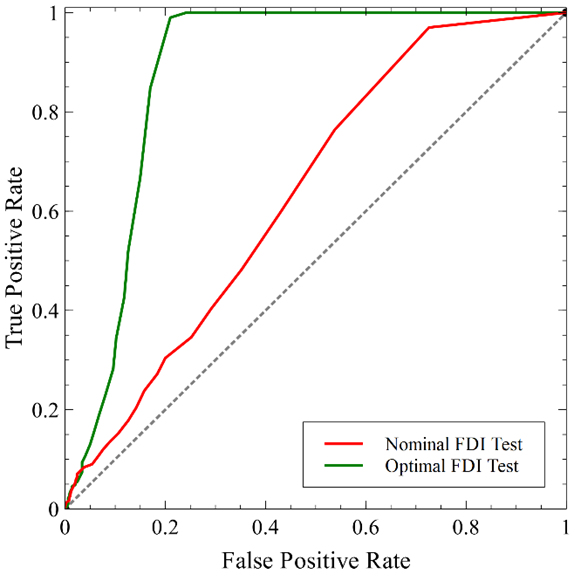
Figure 2. Example ROC plot of a fouled heat exchanger at various fault detection thresholds for particulate fouling at nominal and optimal test designs.
Several case studies comparing the FDI effectiveness (in terms of FAR and NDR) at nominal and optimal test designs will be presented. The first case study will focus on built-in tests for a plate-fin heat exchanger from an aircraft environmental control system (ECS) that is prone to particulate fouling, which extends prior work on fouling quantification.9 The second case study will also focus on particulate fouling in the integrated ECS, to illustrate the impact of increased system complexity of FDI, when multiple sources of uncertainty are present. False alarms and non-detections at nominal test conditions, and their improvement through the proposed framework will be presented. Lastly, the application of the proposed framework on the three-tank benchmark system will be presented. This analysis shows how the design of an active FDI test using the proposed framework compares to more computationally intensive methods proposed in the literature.
This work was sponsored by the UTC Institute for Advanced
Systems Engineering (UTC-IASE) of the University of Connecticut and the United
Technologies Corporation. Any opinions expressed herein are those of the
authors and do not represent those of the sponsor. Help and guidance by Modelon and Modelon-AB are
gratefully acknowledged.
1. Hwang, I., Kim, S.,
Kim, Y. & Seah, C. E. A Survey of Fault
Detection, Isolation, and Reconfiguration Methods. IEEE Transactions on
Control Systems Technology 18, 636–653 (2010).
2. Isermann,
R. Model-based fault-detection and diagnosis - Status and applications. Annual
Reviews in Control 29, 71–85 (2005).
3. Venkatasubramanian,
V., Rengaswamy, R., Yin, K. & Kavuri,
S. N. A review of process fault detection and diagnosis: Part I: Quantitative model-based
methods. Computers & Chemical Engineering 27, 293–311 (2003).
4. Venkatasubramanian,
V. A review of process fault detection and diagnosis: Part III: Process history
based methods. Computers & chemical … 27, 293–311 (2003).
5. Henrik Niemann. A Setup for Active Fault Diagnosis. Automatic
Control, IEEE Transactions on 51, 1572–1578 (2006).
6. Gao, Z., Cecati, C. & Ding, S. X. A survey of fault diagnosis
and fault-tolerant techniques-part II: Fault diagnosis with knowledge-based and
hybrid/active approaches. IEEE Transactions on Industrial Electronics 62,
3768–3774 (2015).
7. Han, L., Zhou, Z.
& Bollas, G. M. Model-based analysis of chemical-looping combustion
experiments. Part I: Structural identifiability of kinetic models for NiO reduction. AIChE
Journal 62, 2419–2431 (2016).
8. Han, L., Zhou, Z.
& Bollas, G. M. Model-based analysis of chemical-looping combustion
experiments. Part II: Optimal design of CH4 -NiO
reduction experiments. AIChE Journal 62,
2432–2446 (2016).
9. Palmer, K. A., Hale,
W. T., Such, K. D., Shea, B. R. & Bollas, G. M.
Optimal design of tests for heat exchanger fouling identification. Applied
Thermal Engineering 95, 382–393 (2016).
10. Bruwer,
M.-J. & MacGregor, J. F. Robust multi-variable identification: Optimal
experimental design with constraints. Journal of Process Control 16,
581–600 (2006).
See more of this Group/Topical: Computing and Systems Technology Division