
Effect of Manufacturing Conditions on the Fabrication of Protein/Polysaccharide Biocompatible Nanotubes (BNTs)
Abstract
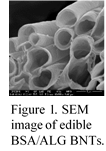 The Layer-by-Layer (LbL) technique with the assistance of a
template is used to allow the formation of single or multilayer nanotubes (Decher, 2002). The
polycarbonate (PC) track-etched nanoporous membranes are one of the most
convenient template materials because they are easily dissolved allowing the
extraction and dispersion (in aqueous solution) of virtually intact nanotubes (Azzaroni &
Lau, 2011; Sadeghi et al., 2013; Saghazadeh et al., 2015). The
PC membranes are available in different pore sizes allowing the fabrication of
nanotubes with different diameters. The pore size and thickness of the
template determines the final dimensions of the nanotubes, including wall
thickness (Alem, Blondeau,
Glinel, Demoustier-Champagne, & Jonas, 2007; Cho, Lee, & Hong, 2014;
Roy, Dupont-Gillain, Demoustier-Champagne, Jonas, & Landoulsi, 2010). The
biopolymers used in the fabrication of BNTs should be easily dispersible in the
solvent of choice, water being the solvent most conveniently used, and should
possess large opposite charges and be able to form secondary bonds
(electrostatic, ionic or hydrogen bonds) with the template membrane and
subsequent layers.
LbL deposition technique has been successfully used to fabricate edible and biodegradable nanotubes with well-defined and controlled structure and properties. To date, there is insufficient understanding of the biopolymer deposition process, especially for edible polyelectrolyte molecules. To address this gap, this research has studied the interactions and operating conditions that lead to the formation of biocompatible nanotubes (BNTs) of bovine serum albumin (BSA) and sodium alginate (SA) through the template-assisted LbL technique, and their application for encapsulation of curcumin as a model if hydrophobic bioactive compound. Dynamic light scattering (DLS) and isothermal titration calorimetry (ITC) were used to study the ability of a protein and polysaccharide to interact and form nanotubes. These methods also offered insight into the types of interactions occurring between these two biopolymers. ITC measurements indicated that interaction between BSA and SA was predominant at pH 3-4, while no interaction occurred at pH 7. This was also correlated by zeta potential measurements that showed opposite charges for these two biopolymers at acidic pH and similar charges at neutral pH. Other assembly parameters, including ratio and concentration of biopolymers, rates of addition, and stability at different pH values were also studied. The optimum concentrations for BSA/SA nanotubes were BSA at 0.8 mg-mL-1 and SA at 0.6 mg-mL-1 with a rate of addition of 1 mL.min-1. The assembly of BNTs was studied with polycarbonate templates of 200, 400, 600 and 800 nm pore sizes. The wall thickness that led to the most stable BNTs was 4 bilayers (BSA/ALG)4. The morphology, outer diameter, thickness of the wall and length of the freeze dried BNTs were characterized with SEM and TEM. The SEM images showed that (BSA/ALG)1 and (BSA/ALG)2 yield a weaker BNT. The application of these nanotubes for encapsulation and release of curcumin was also studied. Curcumin concentrations used were 10, 15 and 20μg.mL-1. The types of interactions occurring between the BNTs and curcumin were also characterized with ITC. The development of optimal biocompatible nanotubes, which enhances the encapsulation and bioavailability of poorly water-soluble curcumin can be used as a delivery system for other bioactive compounds.
Keywords: Biocompatible nanotubes; layer-by-layer technique, polyelectrolyte.
References
1. Alem, H., Blondeau, F., Glinel, K., Demoustier-Champagne, S., & Jonas, A. M. (2007). Layer-by-Layer Assembly of Polyelectrolytes in Nanopores. Macromolecules, 40(9), 3366–3372. https://doi.org/10.1021/ma0703251
2. Azzaroni, O., & Lau, K. H. A. (2011). Layer-by-layer assemblies in nanoporous templates: nano-organized design and applications of soft nanotechnology. Soft Matter, 7(19), 8709–8724. https://doi.org/10.1039/C1SM05561E
3. Cho, Y., Lee, C., & Hong, J. (2014). Pore size effect on the formation of polymer nanotubular structures within nanoporous templates. Colloids and Surfaces A: Physicochemical and Engineering Aspects, 443, 195–200. https://doi.org/10.1016/j.colsurfa.2013.11.013
4. Decher, G. (2002). Polyelectrolyte Multilayers, an Overview. In G. Decher & J. B. Schlenoff (Eds.), Multilayer Thin Films (pp. 1–46). Wiley-VCH Verlag GmbH & Co. KGaA. Retrieved from http://onlinelibrary.wiley.com/doi/10.1002/3527600574.ch1/summary
5. Roy, C. J., Dupont-Gillain, C., Demoustier-Champagne, S., Jonas, A. M., & Landoulsi, J. (2010). Growth Mechanism of Confined Polyelectrolyte Multilayers in Nanoporous Templates. Langmuir, 26(5), 3350–3355. https://doi.org/10.1021/la903121e
6. Sadeghi, R., Kalbasi, A., Emam-jomeh, Z., Razavi, S. H., Kokini, J., & Moosavi-Movahedi, A. A. (2013). Biocompatible nanotubes as potential carrier for curcumin as a model bioactive compound. Journal of Nanoparticle Research, 15(11), 1–11. https://doi.org/10.1007/s11051-013-1931-8
7. Saghazadeh, S., Zhang, S., Lefèvre, D., Le Beulze, A., Jonas, A. M., & Demoustier-Champagne, S. (2015). Universal Method to Transfer Membrane-Templated Nano-Objects to Aqueous Solutions. Langmuir, 31(26), 7264–7273. https://doi.org/10.1021/acs.langmuir.5b01648
See more of this Group/Topical: Engineering Sciences and Fundamentals