Tuesday, 24 April 2007 - 2:25 PM
73b
Generation of Nanoliter Fluid Segment Patterns by Different Methods of Segment Sequence Merging
The generation of complex sequence pattern of nanoliter fluid segments is possible by combination of injectors and T-junctions in a microfluidic network (fig.1). The formation of such segment patterns was studied in modular arrangements of PTFE tubes in combination with PTFE T-junctions and chip devices for segment fusion. The application of simple T-junctions leads to a certain statistical distribution in the fusion events resulting in more distributed sizes and compositions of segments in finally formed sequences. Chip devices with an internal pressure regulation support the formation of a strong conrolled pairwise fusion, if the flow rates are well adapted.
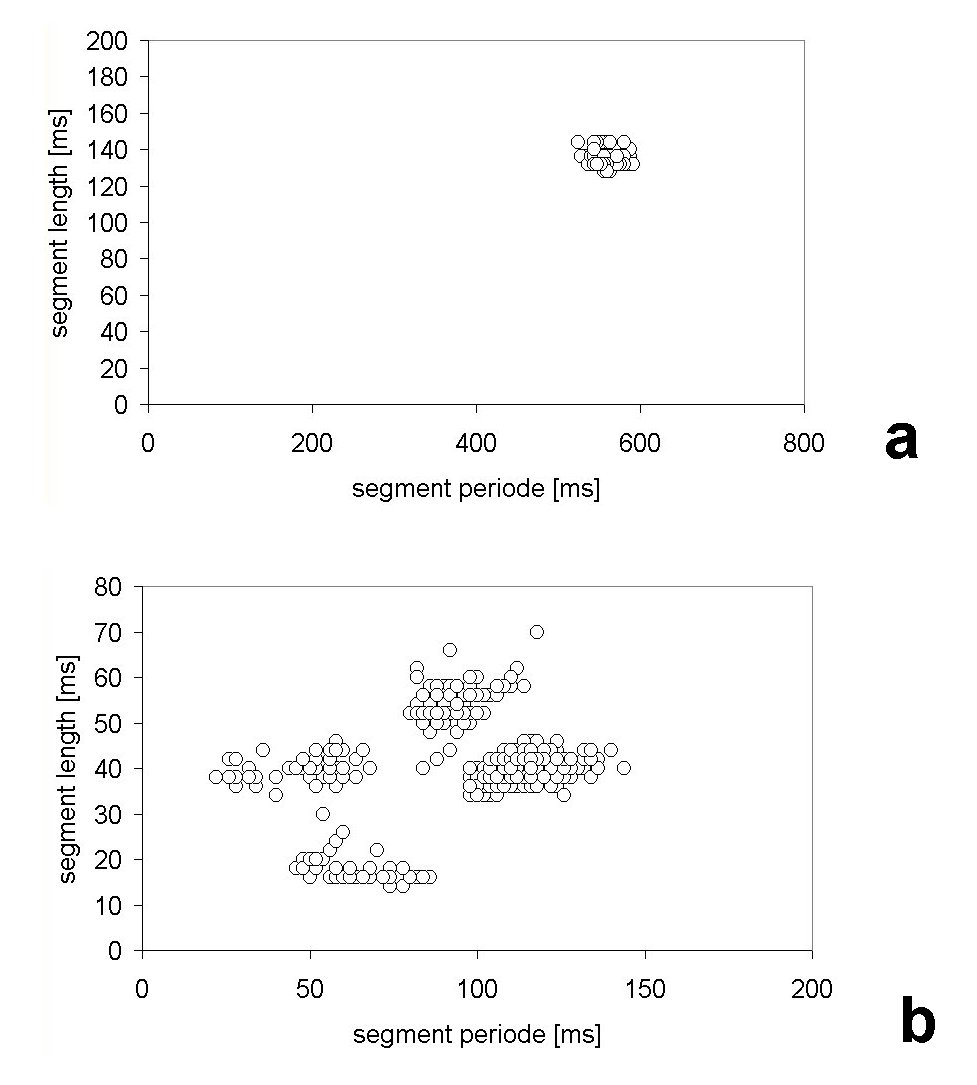
The obtained segment sequences were monitored by micro flow-through photometry allowing a resolution of size and distance in segment measurements better than 1 % up to segment frequencies of more than 10 Hz. Therefore, tube photometers including a LED, an aperture element for illumination and a detector diode are applied. This photometers are working with a relative precision of photometric readout of about 2% down to integration times of 0.2 ms. The formed sequence pattern can be well characterized by the distribution of concentration (absorbance), segment size and distance to the next segment. The segment parameters were extracted from the original absorbance-time data sets. Complex patterns are reflected by the formation of different subpopulations in size-absorbance and size-distance plots (fig.2). The quality of the formed sequence patterns is marked by the parameter scattering inside the single subpopulations of segments.
In result it could be shown, that nanoliter fluid segment pattern of very different character can be produced in dependence on flow rate ratios of carrier liquid and embedded liquids, on coalescence behaviour of originally formed segments and on the topology of the used fluidic network.
Acknowledgement
We thank J. Albert (IPHT Jena), F. Möller and S. Schneider (Ilmenau) for technical assistance. Valuable discussion and support by A Gross and M. Günther (Ilmenau), K. Lemke and A. Grodrian (Heiligenstadt) and financial support by the BMBF (project Serizell) are gratefully acknowledged.
References [1] A. Günther, K.F. Jensen, LabChip 6 (2006), 1487 [2] J.M. Köhler, Th. Henkel, A. Grodrian, Th. Kirner, M. Roth, K. Martin, J. Metze, Chem. Engin. J. 101 (2004), 201 [3] G. Christobal, L. Arbouet, F. Sarazzin, D. Talaga, J.-L. Bruneel, M. Joanicot, L. Servant, Lab Chip 6 (2006), 1140 [4] B. Zheng, J.D. Tice, R.F. Ismagilov, Anal. Chem. 76 (2004), 4977 [5] K. Martin, Th, Henkel, V. Baier, A. Grodrian, Th. Schön, M. Roth, J.M. Köhler, J. Metze, Lab Chip 3 (2003), 202
See more of Topical 1: Applications of Micro-reactor Engineering
See more of The 2007 Spring National Meeting