- 4:35 PM
36h
Microphotochemistry - Photochemistry in Microstructured Reactors
- the thin layers within the micro-channel plates are optimal reaction cavities and allow extensive penetration of the solution by light (® Beer-Lambert's law),
- the photon-efficiencies and consequently space-time yields are improved due to the thinness of the solution,
- the short residence time within the reactors avoid undesired side reactions or decompositions,
- the small scales significantly reduce the amounts of waste and materials and
- energy- and cost-efficient LEDs can be implemented as light sources.
We have demonstrated the potential of microphotochemistry using various model photoreactions, i.e. photoinduced electron transfer reactions involving phthalimides[3] or furanones.[4] All reactions were studied in a commercially available glass reactor (Figure) and were compared to results obtained using conventional Rayonet chamber reactors.
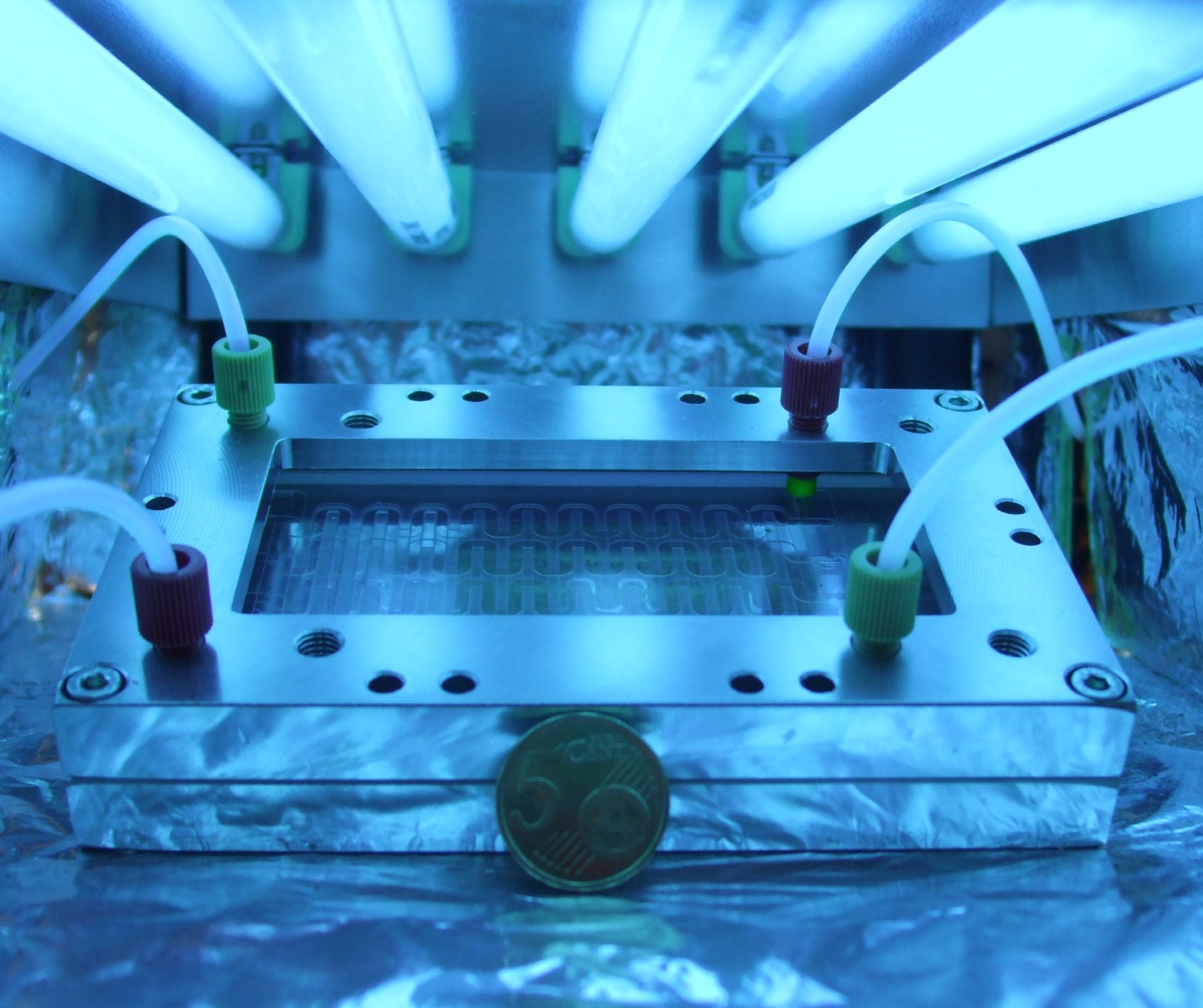
Figure: A glass microreactor (Dwell device, mikroglas) under a UV exposure panel. A five Euro-cent coin is used to illustrate the size of the reactor.
In almost all cases examined the reactions performed in the microreactor gave far higher conversions and consequently yields thus proving the superiority of the microphotochemistry concept.
In an extension of this work, we have demonstrated that photochemical additions to furanones can be achieved in microcapillaries using LEDs.
This research project was funded by Science Foundation Ireland (SFI) and the Environmental Protection Agency (EPA).
[1] Y. Matsushita, T. Ichimura, N. Ohba, S. Kiumada, K. Sakeda, T. Suzuki, H. Tanibata, T. Murata, Pure Appl. Chem., 2007, 79, 1959.
[2] E. Coyle, M. Oelgemöller, Photochem. Photobiol. Sci., 2008, 7, 1313.
[3] (a) M. Oelgemöller, P. Cygon, J. Lex, A. G. Griesbeck, Heterocycles, 2003, 59, 669; (b) A. G. Griesbeck, W. Kramer, M. Oelgemöller, Synlett, 1999, 1169.
[4] (a) S. Bertrand, N. Hoffmann, J.-P. Pete, Eur. J. Org. Chem., 2000, 2227; (b) N. Hoffmann, Tetrahedron: Asymm., 1994, 5, 879.