

Coating plays an important role in the pharmaceutical industry to protect agents or release them in specific parts of the stomach or bowel, but as well in the food industry to protect flavors. The coating is usually applied in a fluidized bed, mainly in a Wurster coater. In this process the particles are transported and dispersed by an air flow in the center of the device while being sprayed on with the coating liquid. After coating in the center region of the Wurster coater, particles are collected again in a part with lower air velocity. The coating process itself, including spraying, hitting of the droplets on the particle, spreading on the surface and solidification or drying influences the final coating quality.
A process of particular interest is coating with hot melt. Natural substances like beeswax, carnauba wax and palm fat are interesting in the food industry, as they do not need to be declared as food additives. Hot melt coating has several advantages including a faster process, as significantly less energy needs to be transferred. Additionally, substances like fats and waxes create a more efficient barrier against vapor compared to water-soluble coatings. The coating process is more difficult to control because of higher viscosity, which leads to larger droplets and lower spreading of the material, and more complex crystallization behavior. The process parameters and the suitability of the coating depend on the crystallization temperature range, which needs to be passed to go from the melt to the solidified coating. An additional challenge is the tendency of the wax coatings to agglomerate.
It is difficult to determine temperatures, drying characteristics and kinetics during the process in the Wurster coater itself. Instead, the coating process was reproduced by fluidizing a single particle in the free stream and spraying on it similar to the work of Link [Link and Schlünder 1997]. The advantage is that the complete information of the spraying process is hence accessible, including the local air velocity.
A test rig was set up to fluidize a single particle in the free stream above a nozzle. Additionally, a second nozzle was installed above the fluidized particle to spray coating liquid. The coating liquid was applied to investigate the influence of isolated parameters on the coating quality. Spraying was done by an ultrasonic nozzle to uncouple droplet size from the nozzle’s air volume flow. The coating can hence be applied in a controlled way. In the free stream the air velocity depends on the particle size and density. The particle fluidization was calculated analytically by balancing drag force and gravity force. The energy transport from the air to the sphere was calculated based on temperature and differential velocity.
The temperature of the particle was adjusted by setting the temperature in the fluidization nozzle. Spraying coating dissolved in water at room temperature changes the temperature on the surface of the sphere. The temperature evolution on the surface of the sphere was monitored by an infrared camera (see Figure 1 left and middle). The evaporation cools the particle until the liquid is completely evaporated, allowing to monitor the coating process. It was hence possible to determine the surface temperature and to monitor the process of drying of the coating on the particle. This allowed to visualize zones with applied coating during the process and to determine the duration of drying of the coating. It showed to be in the range of up to 20 s depending on the sprayed coating volume, temperature and on particle size and air flow. The coating yield in the free stream was low due to the large spraying cone compared to the particle surface size, as well as the fluidization air redirecting most of the liquid from the particle. Still this reproduces the Wurster coater process well. It was possible to create defined coating layers in the levitator. The single particle coating with hot melts, which show a complex drying or crystallization behavior, is currently in work.
The hot melt process was reproduced in a Wurster coater. Taking the crystallization temperature range into account, the process conditions can be realized similarly to solvent-based coatings. While coatings like beeswax tend to agglomerate, different melts like stearic acid could be processed well. The produced coating was investigated in micro-computed tomography to evaluate for a closed coating layer (see Figure 1 right). Hot melt coating showed to be less homogeneous compared to solvent-based coating, with delamination effects on the particle despite the low surface tension of waxes.
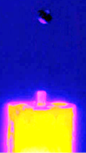

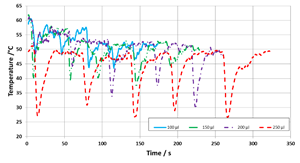
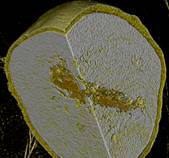
Figure 1: Thermography image of fluidized particle (left); Temperature evolution during spraying different volumes of solvent-based coating (middle); µCT image of a melt-coated particle (right)
References
Link, K. C. and E.-U. Schlünder (1997). "Fluidized bed spray granulation." Chemical Engineering and Processing: Process Intensification 36(6): 443-457.
See more of this Group/Topical: Applications of Solids Processing Unit Operations