Explantation, Capsulectomy, and Mastopexy for Breast Implant Illness: A Prospective Analysis of Patient Satisfaction and Clinical Outcomes
Breast Implant Illness (BII) attributes symptoms of autoimmune illness, fatigue, myalgia, arthralgia, memory, and sleep disturbances to the presence of a breast implant prosthesis. In order to alleviate these symptoms, patients are electing to undergo explantation with capsulectomy. The purpose of this study was to evaluate the clinical effectiveness of explantation, capsulectomy, and mastopexy (E.C.M.) in patients presenting with BII, and prospectively analyze quality of life for patients following this procedure.
Methods/Technique:
Two hundred and thirty-two simultaneous explantation, capsulectomy, and mastopexy procedures were performed in 116 patients from 2014-2019. Fifty-six percent (n=65) of these patients presented with symptoms associated with BII. Prospective quality of life assessment was administered for all patients presenting with BII (100%). Inclusion criteria included a minimum postoperative follow-up of 6 months and completion of a practice-generated pre and post-operative patient reported outcomes (PRO) questionnaire. The PRO questionnaire consisted of 13 questions, where scoring was determined according to a 5-point Likert scale (1=extremely dissatisfied, 5=extremely satisfied for quality of life and breast aesthetics and 1=none, 5=very severe for symptoms). Clinical outcomes were analyzed including patient demographics, operative technique, breast implant specifications, complication rate and reoperation rate. Descriptive statistics were used to analyze patient demographics and clinical outcomes. Wilcoxon signed-rank test was performed to compare changes in quality of life scores.
Results/Complications:
Sixty-five patients were evaluated with a mean follow-up period of 23 months (6 mo to 5 yrs). Mean age and BMI were 42.3 years (26 – 62 yrs) and 24.6 kg/m2, respectively. The primary breast implant procedure wasaugmentation (n=36, 55.4%) or augmentation-mastopexy (n=29, 44.6%). Multiple (≥ 2) previous breast procedures were performed in 27.7% (n=18) of patients prior to explantation. Average time from last implant surgery to the explantation procedure was 8 years 3 months (24 mo. to 20 yrs). All patients underwent bilateral explantation of submuscular (n=40, 61.5%) or subglandular implants (n=25, 38.5%), with capsulectomy, and simultaneous mastopexy. Mastopexy technique utilized was most commonly inverted “T” (n =49, 75.4%), followed by vertical (n = 16, 24.6%), based on a superior or superior medial pedicle. Silicone implants were explanted in 75.4% of patients (n=49) and saline in 24.6% (n=16). Mean fill volume of the implants explanted was 345 cc (250 – 550 cc). Mastopexy was coupled with simultaneous volume restoration though autologous fat grafting in 38.5% (n = 25) of patients, where the mean volume of fat transferred was 200 cc (range 120 - 300 cc). Of the 130 breast procedures performed, the complication rate was 3.1% (n=4), consisting of hypertrophic scarring (n=2 breasts), loss of nipple sensation (n = 1 breast), and areolar asymmetry (n=1 breast) with a reoperation rate of 2.3% (n=3).
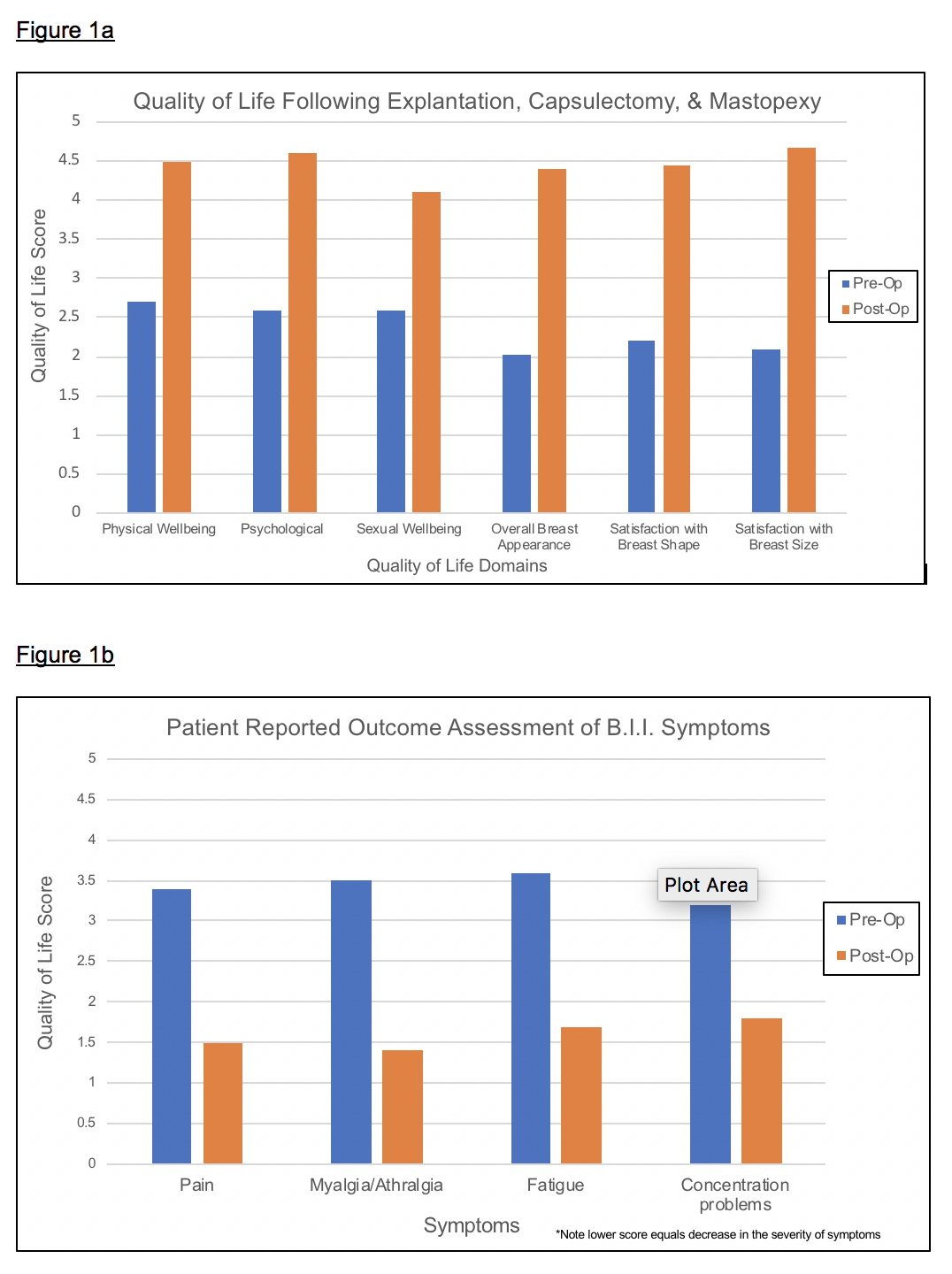
Patient reported outcomes demonstrated a significant improvement in all quality of life domains, including physical well-being (p<0.005), psychological well-being (p<0.005), and sexual well-being (p<0.005) (Figure 1a). Patient satisfaction with regard to aesthetic outcomes also significantly improved, including overall breast appearance (p<0.005), breast shape (p<0.005), and breast size (p<0.005). With respect to BII symptoms, fifty-six patients (86.1%) noted reduced pain, myalgias/arthralgias, and fatigue after E.C.M (Figure 1b). However, nine patients (13.8%) reported no improvement in their presenting symptoms after explantation. Although, 96.9% of patients (n=63) would repeat the surgery, and 98.5% (n=64) would recommend the procedure to others suffering from BII. Sixty-two patients (95.4%) reported that they were satisfied or extremely satisfied with the aesthetic appearance of their breasts post-explantation.
Conclusion:
The emergence of patients presenting with “breast implant illness” has continued to increase in recent years. As a result, patients request breast implant removal and look to plastic surgeons to alleviate symptoms. This study presents an effective treatment paradigm to manage implant removal through simultaneous explantation, capsulectomy, and mastopexy with significant improvements in various quality of life domains. In patients for whom explantation is indicated and replacement was not an option secondary to BII concerns, ECM can be performed simultaneously with acceptable complication and reoperation rates, as well as improvement in overall breast aesthetic.