Structural Mastopexy: Restoration of a Compact and Balanced Breast Shape
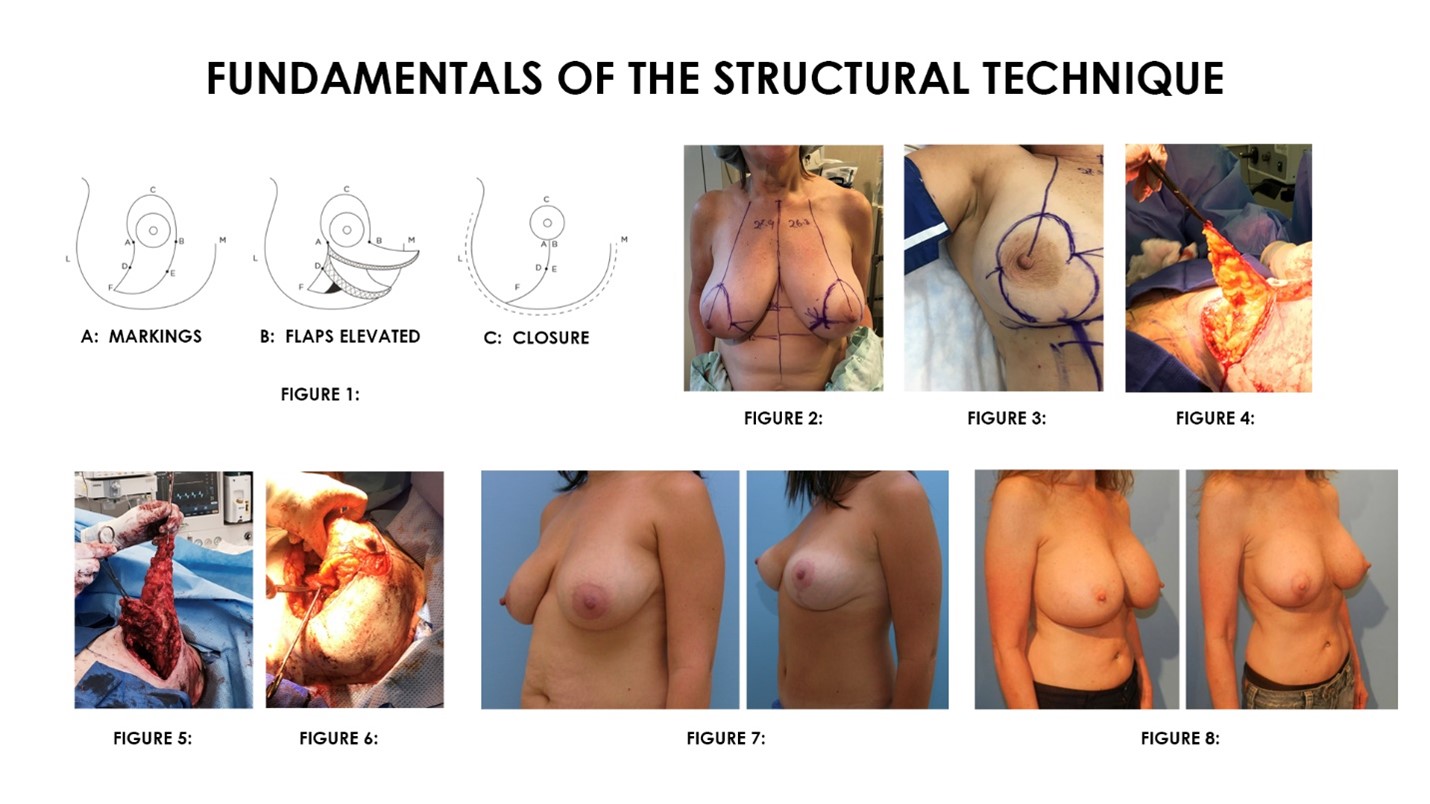
Many breast lift and breast reduction techniques are limited by their design. There is a tendency for the lower pole of the breast to stretch over time (bottoming out) and for the upper pole of the breast to lose volume. The structural technique is inspired by the work of Dr. Ermette De Longis, who devised a method of mastopexy that moves the central inferior breast tissue into the upper pole of the breast and anchors this in place with a dermoglandular flap that passes through the pectoralis major muscle (Figure1). The inferior aspect of the vertical scar sweeps laterally in a gentle curve, which tightens the base of the breast and eliminates the redundancy that occurs at the base of many vertical mastopexies. The net effect is a dramatic recompaction of the breast tissue and a significant restoration of upper pole fullness. The technique can be applied to mastopexy, reduction, augmentation-mastopexy, and breast revision. In this presentation the fundamentals of the technique will be described along with clinical examples of its applications.
Often patients desire breast lift surgery but prefer to avoid breast implants. With many breast lift techniques there is a lack of long-term fullness in the upper portion of the breasts. As a result, plastic surgeons frequently resort to routine use of implants in the mastopexy operation. This may lead to a result that is larger than the patient desires. For many patients the structural technique allows for a lift without implants, as natural breast tissue is transposed to provide upper pole volume.
Methods/Technique
:The patient is marked with her arms by her sides. The midline of the body and the midaxis of each breast are marked, as well as the existing inframammary fold level (Figure 2). The new position of the superior areolar border is marked on the midaxis, typically 2 cm above the transposed position of the inframammary fold (Point C). The skin is pinched to determine the extent of periareolar resection (Points A and B). The breast is displaced medially and laterally and the point where the displaced breast overlies the midaxis is marked medially and laterally (Points D and E). Curves are constructed that pass through these points and intersect superiorly with points A and B. Beneath Points C and D the curves incline toward a point at the inferolateral breast above the existing inframammary fold (Figure 3).
The new areolar border is marked and deepithelizliation is carried out. A superiorly-based dermoglandular flap is elevated off the lower central breast tissue (Figure 4). The underlying central breast segment is released medially, laterally, and inferiorly and is elevated off the subglandular plane (Figure 5). Mobilization continues beneath the breast, which creates a space into which the tissue can be transposed. With the breast tissue flap now in the upper pole, the dermoglandular flap is passed through an opening in the pectoralis muscle and anchored in place. The medial and lateral pillars are sutured together until the new inframammary fold level is reached, then the closure inclines laterally. This, along with vigorous liposuction, sets the new base of the breast (Figure 6). The incisions are closed in the usual way.
Results/Complications
:A total of 180 patients have been treated with this technique. One patient early in the series required a second operation to further lift one breast. Two hematomas were treated by aspiration. Four patients required minor revision of the surgical scars under local anesthesia. There were no infections or serious complications requiring hospitalization.
The technique provides balanced volume to the upper pole of the breast (Figure 7) and can be combined nicely with implant down-sizing (Figure 8). It is also useful for patients who desire implant removal and lift, if there is sufficient tissue in the lower portion of the breast.
The structural technique provides surgeon and patient with three advantages: multilevel anchoring of tissue to maintain breast shape, the creation of a natural fullness in the upper portion of the breast, and the avoidance of a surgical scar at the medial aspect of the breast.
Conclusion
:The structural technique is an effective surgical method to restore the breast to a proper position and compact structure. The technique provides significant restoration of upper pole fullness without the need for implants. Complications are minor and infrequent.