Volumetric Analysis and Quality of Life Outcomes after Hyaluronic Acid Injectable Facial Fillers
Methods/Technique: Women aged 40-65 were recruited and consented. Patients were excluded if they had a prior history of facial rejuvenation procedures, underwent prior minimally invasive procedures within the last 12 months, had a history of congenital facial paralysis or asymmetry, and/or were currently on blood thinners. Patients were injected in four areas using the following: Restylane-L® in the nasolabial folds and marionette lines, Restylane-L Lyft® in the malars, and Restylane Silk® in the cutaneous vermillion border. Patients completed 12 independent domains of the FACE-Q quality of life questionnaire and were photographed pre-injection (baseline), immediately post-intervention, 2 weeks post-injection, and 4 weeks post-injection using 3D Vectra® M3 Imaging Software. For volumetric analysis, two 3D images were layered and matched. Subjects were included if calibration of images met current standards for 3D facial analysis. The FACE-Q was scored for overall satisfaction in each domain.
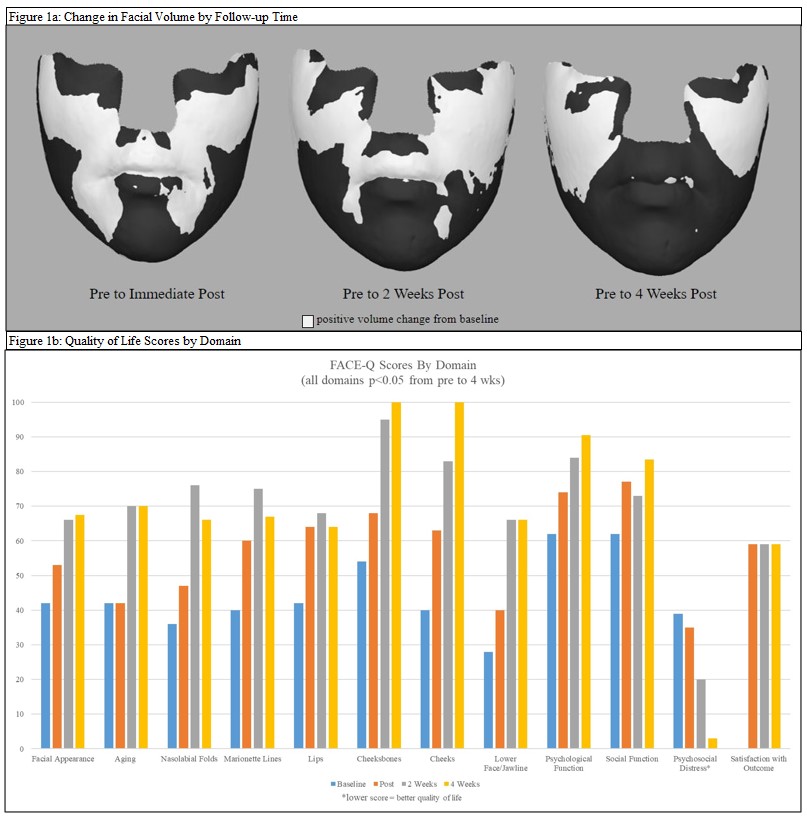
Results/Complications: Thirty-one women were consented, enrolled, and received intervention. Six subjects were excluded from volumetric analysis due to inadequate image calibration. For the 25 subjects included in analysis, median age was 52.8 (interquartile range [IQR] 50-57) and follow-up was 4 weeks post-injection. On 3D image analysis, a median of 88.2% of injected volume was maintained at 2 weeks post-injection (IQR 69-124) and 81.4% of injected volume was maintained at 4 weeks post-injection (IQR 57-140, FIGURE 1a). In terms of PROs, improvement was seen from baseline to immediately post-injection in appraisal of facial appearance, marionette lines, cheekbones, cheeks, lower face/jawline, psychological function, and social function (n=31, all p<0.05). Continued improvement was seen from baseline to 4 weeks post-injection across all 12 FACE-Q domains (all p<0.05, FIGURE 1b). There were no significant differences in domains from 2 weeks to 4 weeks post-injection (all p>0.05).
Conclusion: Our preliminary results support that hyaluronic acid dermal facial fillers maintain volume at 4 weeks post-injection. FACE-Q scores demonstrate improved quality of life immediately after injection, and this improvement is maintained through 4 weeks-post injection across domains. This study is ongoing with an enrollment goal of 100 patients and a 3-month follow-up evaluation to examine long-term results of these hyaluronic acid dermal facial fillers.