The “Smile Mastopexy”: A Novel Technique to Aesthetically Address the Excess Skin Envelope and Allow Nipple Areolar Complex Preservation during Immediate Implant-Based Breast Reconstruction.
With the increase in immediate, implant-based breast reconstruction, surgeons continue to expand the application of this technique with regards to nipple preservation and shaping of the skin envelope. Classically large, ptotic breasts have been a contraindication for nipple preservation. Here we present a technique to both reduce the excess skin envelope and preserve the nipple areolar complex (NAC) at the time of mastectomy. Unlike the transverse pattern mastopexy where only vertical excess is addressed, the “smile” pattern allows a reduction in the vertical, as well as horizontal excess while avoiding a “T-Junction”, which is notorious for wound healing complications. The design of the final scar allows for future adjustments of nipple position and skin envelope refinements in the event of lower pole stretching.
Methods/Technique
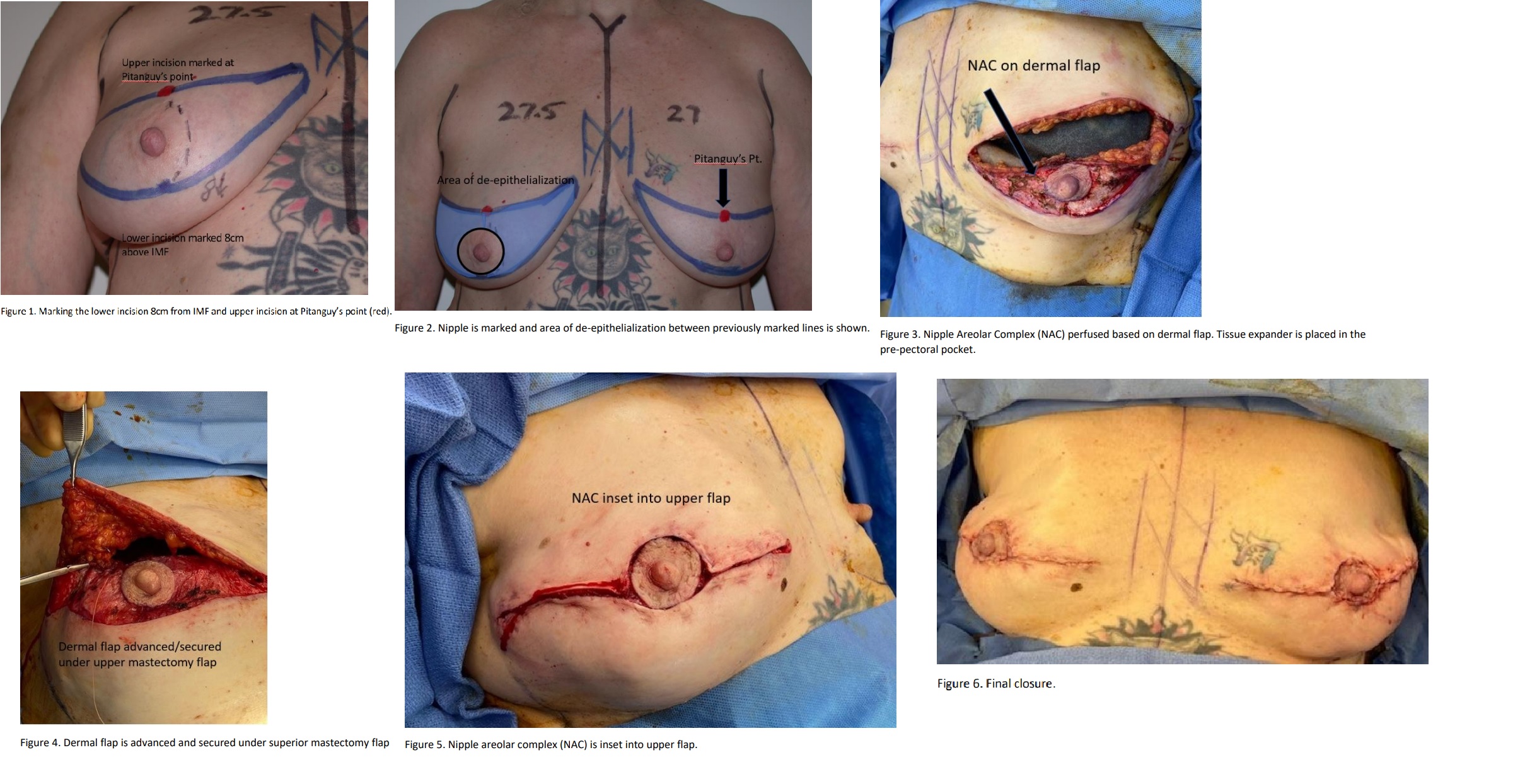
:This is a retrospective review of single surgeon experience performing the “smile mastopexy” for implant-based breast reconstruction. The smile mastopexy is designed at the time of pre-operative marking. In a standing position, the new nipple location is determined using Pitanguy’s point. The upper incision is marked in parallel of the lower border of the breast making sure that the medial extent does not extend beyond the assumed location of a brassiere. Next 8cm is measured from the IMF towards Pitanguy’s point, which then becomes the new N-IMF distance. The excess skin between these marks is de-epithelialized and the nipple-areolar complex (NAC) is kept on this adipo-dermal flap. The mastectomy is then performed through the upper incision. After placement of the tissue expander, the dermal flap is advanced under the superior mastectomy flap and secured, providing additional thickness to the upper pole. Lastly, a full thickness window is created in the superior flap for NAC inset at the previous marked location, and all incisions are closed (see figures 1-6). All reconstructions were performed in the pre-pectoral plane without the use of acellular dermal matrices although this technique can also be used for subpectoral technique. In addition, a similar technique can be used in case of proximity of tumor to the nipple in which case the nipple is removed, the defect is closed in a pursed string fashion while the areola is preserved.
Results/Complications
:A smile pattern mastopexy was designed for each patient pre-operatively. In all cases a tissue expander with an integrated drain port was placed at the time of mastectomy. Our study included 19 patients and a total of 34 breasts. Mean age was 50 years old, mean BMI kg/m2 was 31.6, and mean mastectomy specimen weight was 690 grams. All patients had either class 2 (2/19, 10%) or class 3 (17/19, 90%) ptosis preoperatively. There were no cases of complete nipple loss, however one patient experienced partial nipple loss. There was one case of partial mastectomy skin flap necrosis which required debridement. The most common complications were minor wound healing issues (2/19, 10%), which were treated with conservative measures. There were no reconstructive failures in our group.
Conclusion
:The “smile mastopexy” is a reliable method that can be used during immediate stage 1 implant-based breast reconstruction to preserve the nipple areolar complex while reducing the excess skin envelope in large, ptotic breasts. It is a powerful technique that can lead to improved aesthetic outcomes in patients that may otherwise not be candidates for NAC preservation. The additional thickness to the upper flap also reduces the appearance of rippling. Because of the dermal flap, the option for free NAC grafting if needed, is also preserved. Lastly, this technique allows for future adjustments in nipple position and the lower pole length without the addition of new scars, especially in the setting of radiation induced asymmetry.