Preoperative Risk Factors and Complication Rates of Breast Augmentation with Fat Grafting
Methods/Technique: Patients undergoing breast augmentation with AFG as well as with implants between 1/2/2017 and 7/31/2019 were identified within the prospectively enrolled CosmetAssureTM database (Birmingham, AL). The primary outcome was the occurrence of covered major complication(s) requiring emergency department visit, hospital admission, or reoperation within 45 days postoperatively. Age, gender, body mass index, smoking, diabetes, type of facility, ASA class, and type of anesthetic were evaluated as risk factors. The secondary outcome was the comparison of breast augmentation with AFG to breast augmentation with implants.
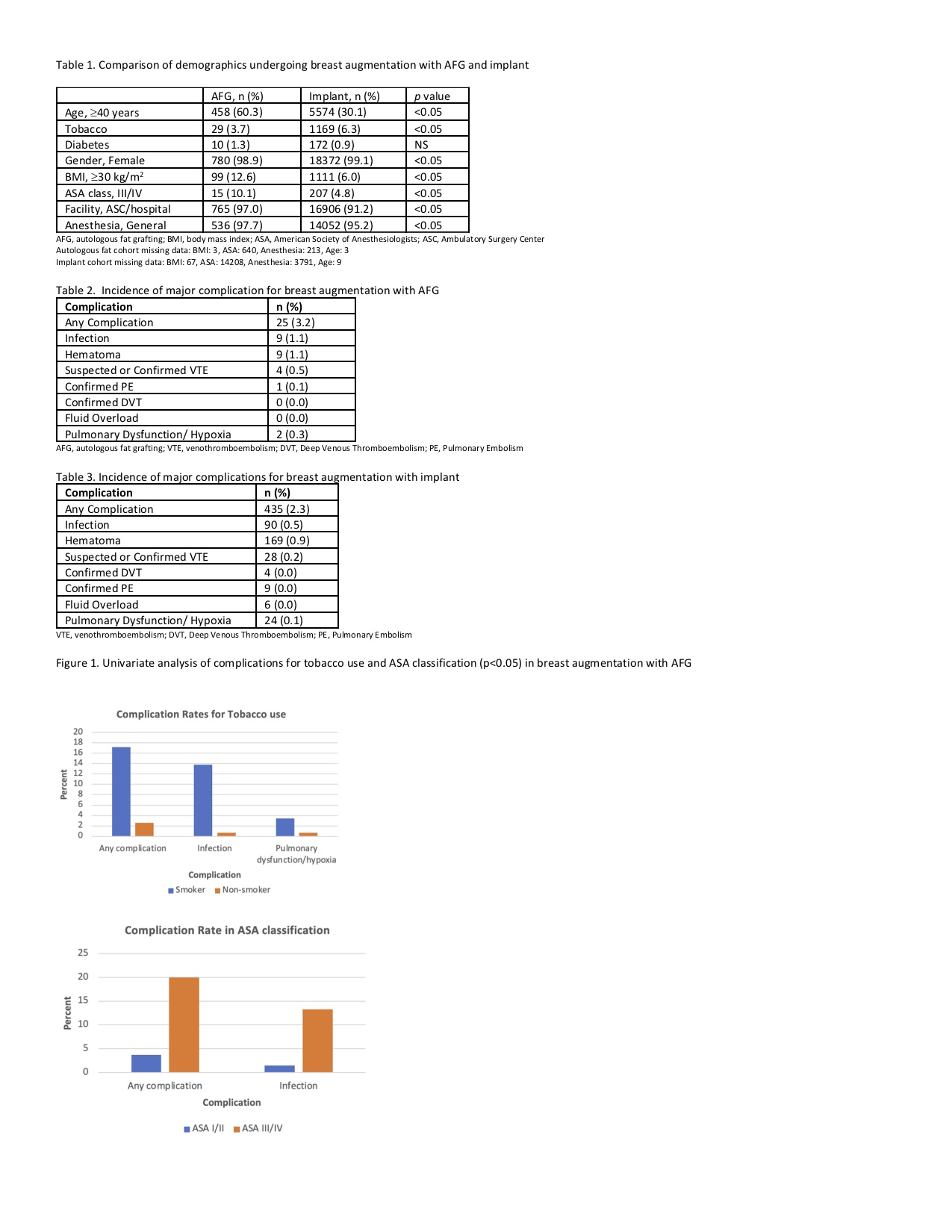
Results/Complications: Among the 76,128 patients enrolled in CosmetAssureTM, 789 (1.0%) underwent breast augmentation with AFG, while 18,544 (24.3%) underwent breast augmentation with implants. The AFG cohort was more likely to be >40 years, female, obese, ASA class III/IV, operated on at an ASC/hospital under general anesthesia, and less likely to use tobacco compared to the implant cohort (Table 1). The incidence of any major complication in the AFG cohort and implant cohort was 3.2% and 2.3%, respectfully. Infection was significantly higher in the AFG cohort compared to the implant cohort (1.1% vs 0.5%, p<0.05). The most common complications in the AFG cohort were infection (1.1%), hematoma (1.1%), suspected/confirmed VTE (0.5%), and pulmonary dysfunction (0.3%). Table 2 and 3 depict complication rates for breast augmentation with AFG and with implants, respectively. On univariate analysis, for the AFG cohort, tobacco users were more likely to have any complication, infection and pulmonary dysfunction/hypoxia; ASA class III/IV was more likely to have any complication and infection (Figure 1). On multivariate analysis, smoking was an independent risk factor for any complication (RR=17.1, CI 2.2- 134.3, p<0.05) and infection (RR=20.2, CI 1.5-264.8, p<0.05).
Conclusion: Infection and hematoma are the most common major complications in breast augmentation with AFG. Tobacco use is the only independent risk factor for overall complications and infection. Breast augmentation with autologous fat grafting has a higher infection rate than breast augmentation with implants. These findings pose the question for the possible need for antibiotic coverage after breast augmentation with AFG, particularly for tobacco users.