Incidence of Major Complications after Gluteal Augmentation
Gluteal augmentation (GA) has significantly increased in the past decade and continues to gain popularity. The safety profile is a common topic of debate with the true incidence of major complications, particularly in gluteal augmentation with autologous fat, being largely unclear. The purpose of this study is to report the incidence of major complications following gluteal augmentation.
Methods/Technique:
Patients undergoing gluteal augmentation with either implant or autologous fat between 1/2/2017-7/31/2019 were identified within the prospectively enrolled CosmetAssure™ database. The primary outcome was the occurrence of covered major complications requiring emergency department visit, hospitalization or reoperation within 45 days postoperatively. Risk factors for complications and number of deaths were also investigated.
Results/Complications:
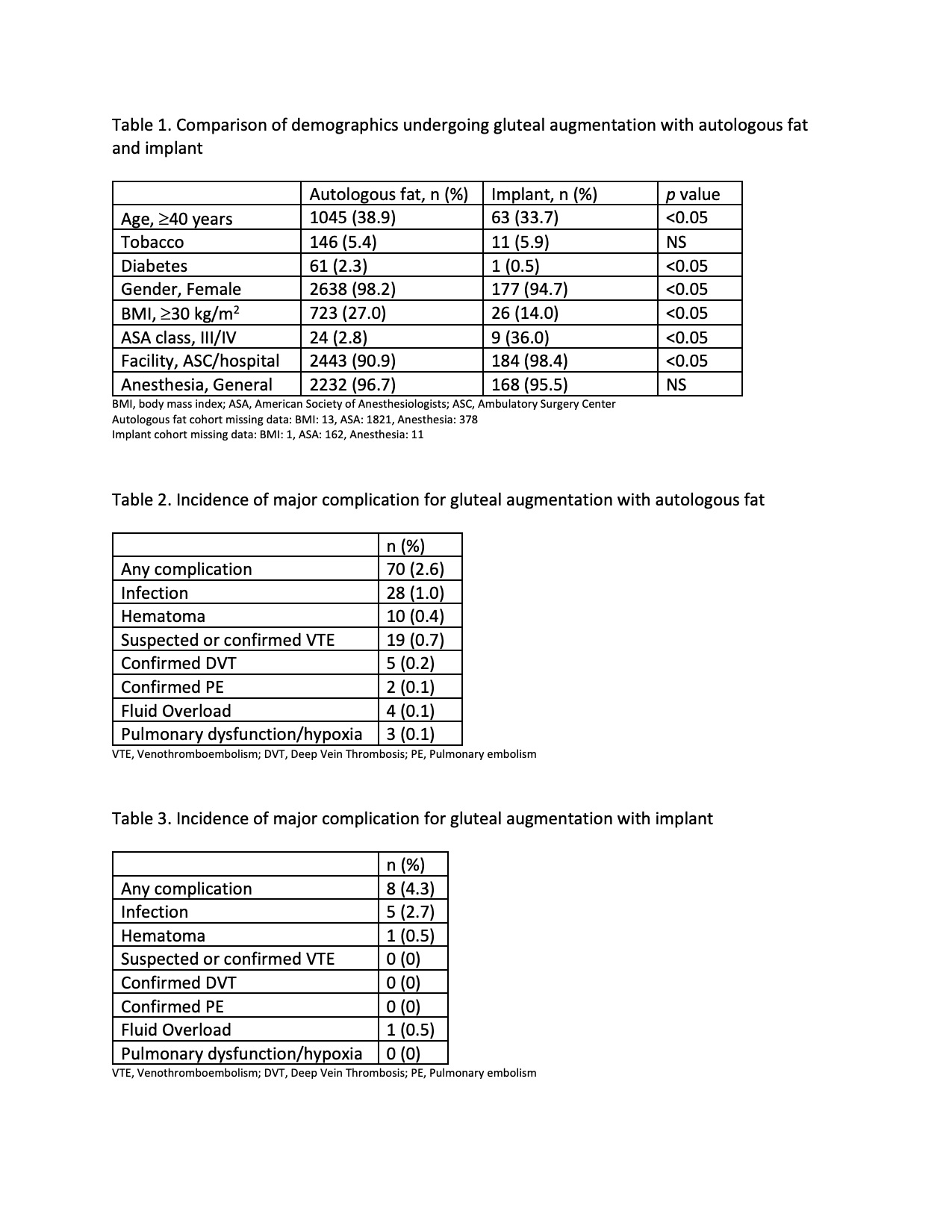
Among 76,128 patients enrolled, 2687 (3.5%) underwent gluteal augmentation with autologous fat and 187 (0.25%) underwent gluteal augmentation with implant. The autologous fat cohort was more likely to be diabetic, age >40 years, female, and obese, and less like to be ASA class III/IV, and surgery performed at ambulatory surgery center (ASC) or hospital compared to the implant cohort (Table 1). The incidence of any major complication in the autologous fat cohort was 2.6% and 4.3% for patients undergoing gluteal augmentation with implant. The most common complication in both cohorts was infection. Two (0.1%) patients undergoing fat augmentation and no patient undergoing implant augmentation were found to have a pulmonary embolism. Tables 2 and 3 highlight the complication profile of each group. On univariate analysis, within the autologous fat cohort, age >40 years was a risk factor for pulmonary dysfunction/hypoxia (0.3% vs 0%, p<0.05), office based surgical suites (OBSS) was a risk factor for infection (2.9% vs 0.9%, p<0.05) compared to ACS/hospital, and anesthetic with local/sedation was more likely to have any complication or fluid overload compared to general anesthesia (6.5% vs 2.3% and 1.3% vs 0.1%, respectively, p<0.05). No gluteal augmentations resulted in death.
Conclusion:
Gluteal augmentation with autologous fat is more commonly performed than with implant. The most common major complication after gluteal augmentation, irrespective of method, is infection. Gluteal augmentation appears to be safe, with incidence of major complications, including pulmonary embolism and death being low when performed by ABPS board-certified plastic surgeons or ASPS candidate members. Extra caution to utilize safe techniques should continue to be employed.