Reporting of Online Complications for Botox, Fillers, and Chemical Peels
Botulinum Toxin Type A (Botox), soft-tissue fillers, and chemical peels were the most popular and fastest growing cosmetic minimally invasive procedures in 2019. Although office-based procedures such as Botox, soft-tissue fillers, and chemical peels are reliable and effective, complications can arise that must be addressed. With Botox and soft-tissue filler injections, the most common complications are bruising, erythema, and pain. However, more severe associated complications can occur, such as muscle paralysis, lagophthalmos, orbicularis oris muscle incompetence, anaphylactic reactions, and dysphagia from Botox toxin spread and granuloma formation, blindness, and vascular occlusion from soft-tissue fillers. Chemical peels can lead to erythema, irritation, burning, as well as more serious scarring. These complications can emerge even with the most precise technique and therefore must be mentioned to patients during the informed consent process. Since many patients use the internet to learn more about procedures, it may be beneficial to mention these complications on cosmetic injectable websites.
The objective of this study is to evaluate what complications are described for Botox, soft-tissue fillers, and chemical peel procedures online and to make comparisons on the level of reporting from various sources to understand how to fill some of the existing gaps.
Methods/Technique
:The top 50 google search results for “Botox,” “Fillers,” and “Chemical Peel” were analyzed on their reporting of relevant complications. Websites were categorized based on their origin, “academic/hospital,” “commercial,” “private practice board-certified,” “private practice not-board-certified,” “online heath reference,” and “other” websites. The “other” category consisted of government, reference, news, social-media or online magazine sites. A check list of the most common and serious side effects were gathered for each procedure using the FDA’s guidelines as well as from the literature. This checklist was used to assess each website and their reporting of specific complications. Furthermore, an overall complication, prevention, management, prevalence, and disclaimer score were assigned to each site. The complication score (out of 5 points) assessed how well a website informed patients about potential side effects specific to that treatment. The prevention score (0 or 1) assessed if the site mentioned anything about ways to prevent possible complications. The management score (0 or 1) assessed if the site described ways to treat complications once they arose (e.g. applying ice to reduce swelling). The prevalence score (0 or 1) assessed if the site gave any estimation to the likelihood of a side effect. Finally, the disclaimer score (0 or 1) assessed if the site offered any sort of disclaimer suggesting that there may be other or more side effects not listed on the site.
Results/Complications
:A total of 136 websites were analyzed, including 42 for “Botox,” 44 for “filler,” and 50 for “chemical peel.” Fifteen websites were excluded as irrelevant, duplicate, or video-based. From the selected sites, 46 (34.1 percent) were private practice board-certified physician-based. Twenty-three (17.0 percent) were developed from online health reference sites. Twenty-three (17.0 percent) were categorized as “other” sites, that included online magazine articles, government based sites, and general reference sites. Twenty-one sites (15.6 percent) were developed by either an academic board or a hospital. Twelve sites (8.9 percent) were categorized as commercial. Ten sites (7.4 percent) were from private practice not-board certified physicians.
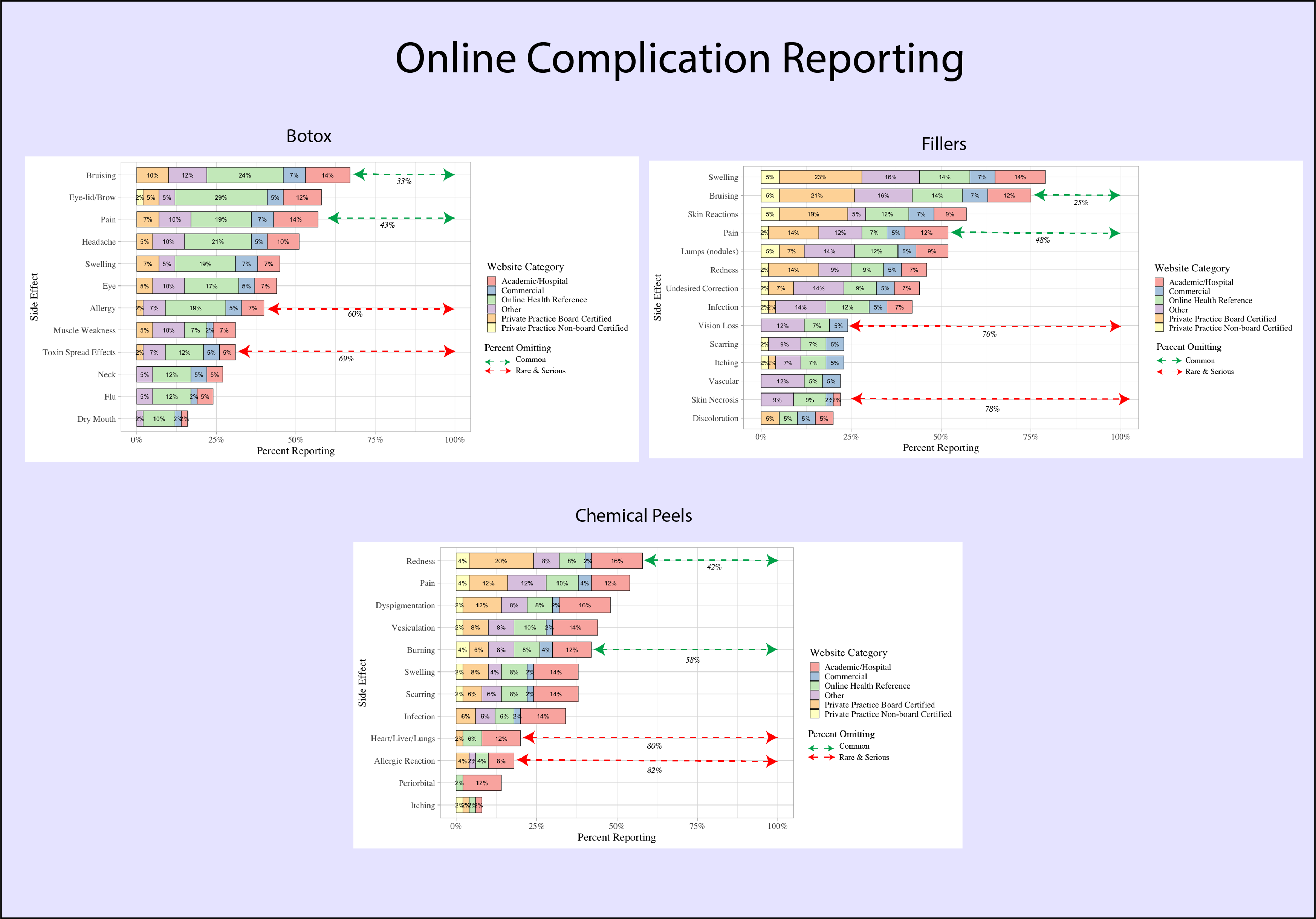
Thirty-one (22.7%) of websites did not mention any complications or risks associated with a treatment. The most commonly reported complications were bruising (67.0%) for Botox, swelling (79.0%) for fillers, and redness (58%) for chemical peels. The least reported serious complications were toxin spread effects (31.0 percent) for Botox, vision loss (23.0%) for fillers, and allergic reaction for chemical peel (18.0%). Serious and rare side effects were reported significantly lower than common side effects, Botox (P=.001), fillers (P=.004), and chemical peels (P<.001). The overall mean (SD) complication score across all websites was 2.81/5 (1.31). Approximately half (49.6 percent) of all sites mentioned ways to prevent complications before treatment. Even less (43.7 percent), mentioned strategies on how to manage complications after they occur. Online health reference and academic/hospital sites disclosed complications better than most other categories (P<.001).
Conclusion
:The increasing popularity of Botox, fillers, and chemical peels warrants high quality online information where patients are not only educated on all possible benefits and alternative treatments, but also on all aspects of risks and complications. The disclosure of complications for Botox, fillers, and chemical peels online are highly variable, biased towards common over serious side-effects, and different among website categories. Online health reference and academic/hospital websites are more comprehensive and should serve as a patient’s primary online source of education for risks and complications. Improvement of cosmetic websites and higher standards of complication disclosure are needed.