Transconjunctival Tucking of Anterior Layer of Levator Aponeurosis : Ptosis Correction
The authors have previously published the paper on the correction of ptosis using the anterior layer (ant. layer) and have accumulated considerable experience, with predictable outcomes. However, locating the anterior layer during surgery is technically challenging, and even if found, creating an accurate flap can be difficult. Therefore, the authors devised a non-incisional conjunctival approach to tuck the anterior layer, making it easier to use in correcting mild and moderate ptosis, and report favorable results.
Methods/Technique
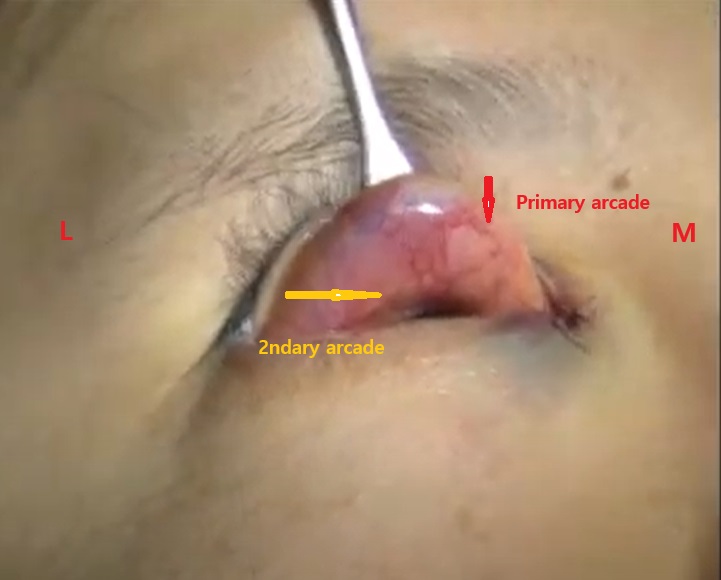
:From 2012 to the present, anterior layer tucking via a non-incisional conjunctival approach was performed on 329 patients, aged 11 to 42 years (mean age: 23.4), with mild to moderate ptosis. The double eyelid line was designed approximately 6-10 mm above the eyelashes on the upper eyelid skin, with six evenly spaced marking points. A step incision was made using a #18 gauge needle, and then a 7-0 nylon suture with a long needle was passed from the skin to the conjunctiva at the level of tarsal plate upper margin, proceeding 10 mm cranially over second arcade, then back down to the upper margin of the tarsal plate before returning to the skin. This was repeated continuously three times, ensuring at least two sutures passed through the anterior layer and secured to the upper margin of the tarsal plate. For moderate cases, a small 2 mm incision was made at 5th hole to cut the inferior transverse ligament (conjoined tendon) to accomplish check rein release.
Results/Complications
:Postoperatively, most patients showed good outcomes, although there were instances of temporary lagophthalmos; however, the majority resolved within two weeks without issues regarding eyelid opening and closing. There were no cases of postoperative dry eye. One of the side effects of non-incisional blepharoplasty, double eyelid loss, occurred in about 7% of cases, but there were no complete recurrences of previously corrected ptosis.
Conclusion
:As the authors have previously presented, the anterior layer of levator aponeurosis plays a crucial role in the correction of ptosis. In situations where surgical incisions are undesirable or technically challenging, the non-incisional conjunctival approach for anterior layer tucking presents a valuable alternative for the correction of mild to moderate ptosis