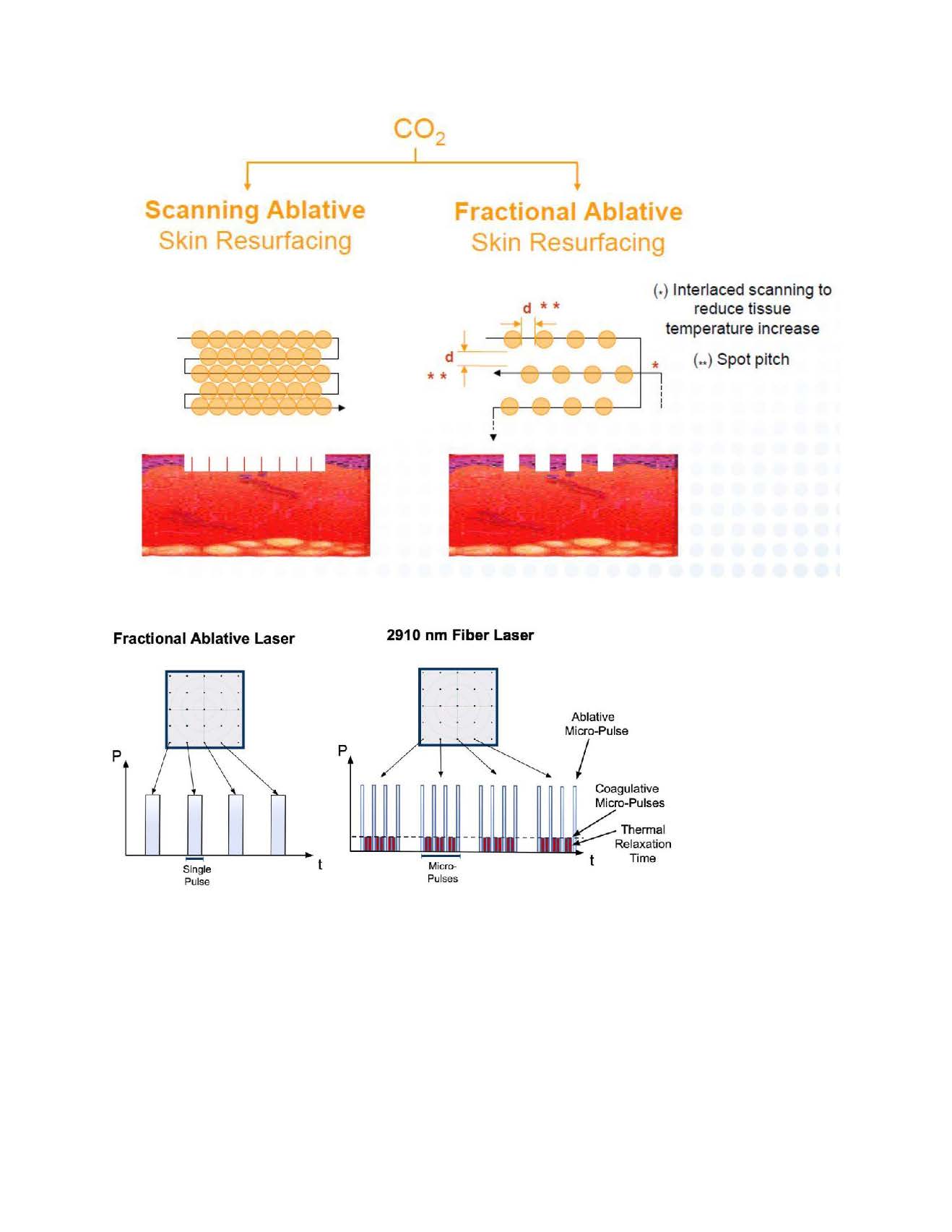
Shifting the Paradigm; Progression from Traditional and Fractionated CO2 Laser to 2910 Nm Erbium-Doped Fluoride Glass Fiber Laser for Selective Photothermolysis and Tissue Tightening Using Non-Invasive Laser Coring in the Aesthetic Patient.
Conventional lasers such as CO2 and Erbium:YAG have been long used to address facial aging concerns. Often with high rates of patient discomfort, long healing times and in some cases dissatisfaction with aesthetic outcomes. There is no question that the most important innovation after ablative full field CO2 laser resurfacing and 2940 nm Erbium:Yag was invented back in the 1980 was the delivery system using fractionated laser in 2004. Fractionated laser allowed laser resurfacing to be done more efficiently and more tolerable. It also reduced dramatically the recovery from the procedure allowing a more rapid repithelialization and decreased the risks of server scarring, ectropion and depigmentation associated with full field ablative laser.
While other energy-based technologies such as non-ablative lasers and RF Mirconeedling can be an alternative option for patients offering less downtime, muted aesthetic outcomes and lower patient satisfaction tends to follow. Additionally, there remained an unmet need to offer an ablative fractional laser solution with less discomfort and downtime without compromising tissue interaction and aesthetic outcomes for patients.
Additionally, use of conventional laser technologies (CO2 and Erbium:YAG) regularly required additional advanced anesthesia increasing patient expenses and risks. The use of conventional non-ablative laser technologies (1550nm & 1927nm Erbium;Thullium) usually requires multiple patient visits for the desired result which resulted in poor overall compliance.
We present 21 cases of customized laser resurfacing utilizing a novel ablative 2,910 nm fiber laser for deep and superficial ablative photothermolysis of which 8 were also treated with non-invasive tissue laser coring with the same device..
Methods/Technique
:Patients of Fitzpatrick skin type II - IV presenting with facial aging concerns, were treated with a single treatment session utilizing a new mid-infrared ablative fractional 2910 nm erbium-doped fluoride glass fiber laser (2910 Fiber Laser) (UltraClear; Acclaro Medical; Smithfield, RI) to address skin laxity, pigmentation and tissue ptosis. Advanced anesthesia measures was used only in combination with surgery and not required when the laser was done independently, solely topical topical anesthetic and/or nitrous oxide was utilized. Multiple passes utilizing laser coring to areas of desired tightening with a subsequent single pass of a combined superficial and deep ablative fractional mode to the entire treatment area. The patients that underwent facial plastic surgery procedures included eyelid surgery, face and neck lift and brow lift; 1 patient underwent a lip lift at the same time.
Photographs were taken at baseline, post procedure and for multiple weeks following treatment. Evaluation of pre-treatment and post-treatment photos was completed by independent reviewers. Reviewers were asked to rate the degree of improvement using a 5-point Global Aesthetic Improvement Scale (GAIS) as follows: (1) worsened (2) unaltered, (3) improved, (4) very significant improvement (5) optimal cosmetic result for this patient.
Results/Complications
:A total of 21 patients underwent treatment. 6 patients were male and 15 were female. Majority of patients had clinical diagnoses of rhytidosis and age related pigmentation. Out of the 21 patients 8 were done along with surgical procedures and 13 subjects had laser resurfacing alone. None of the standalone lasers required advanced anesthesia. Erythema and edema were reported in the immediate postoperative period with minimal discomfort and no pain from the laser. There was one instance of prolonged redness and healing; but no scarring, discoloration or hyperpigmentation seen in the treated patients. Overall the recovery from the laser was completed between 4 and 7 days with full repithelialization; only the patients that underwent laser coring at the same time had some prolonged spots in the background. Evaluation of digital images revealed an average GAIS score of 4.2 at 6 weeks follow up.
Conclusion
:Our early experience demonstrates that treatment with a novel 2,910 Fiber Laser is safe and effective for laser resurfacing alone and in combination with surgery with decreased pain and downtime compared to traditional and fractional CO2 laser resurfacing. The ability to perform an ablative laser with solely topical anesthesia at superficial and deep levels opens the door to patients concerned about advanced anesthesia side effects. Furthermore, the ability to add non-invasive tissue tightening with laser coring in the same platform adds efficacy and efficiency to the rejuvenation patient. Future clinical studies with multiple treatment sessions are currently ongoing at our institution to better understand clinical efficacy, durability, and optimal treatment settings.