A Biomechanical Analysis of Barbed and Monofilament Suture in an Ex Vivo Skin Closure Model
Methods/Technique:
The skin from each patient was cut into two identical 5 cm by 2.5 cm samples, such that each patient served as their own control. Each sample was sectioned along the horizontal midline into two identical halves which would later be sutured together. The sample width of 2.5 cm was selected to precisely match the 2.5 cm width of the tensiometer arms utilized for stress testing (Instron High Precision Soft Tissue Testing System, Model 5848, Instron Corporation, Norwood, MA). Therefore, it was ensured that the stress forces applied by the tensiometer would be equally distributed across all points along the length of each specimen.
For each patient, the samples were randomized to one of two skin closure methods: knotless or layered. The knotless closure, the technique under investigation, consisted of a running subcuticular with 3-0 unidirectional barbed suture, which is equivalent in diameter to a 3-0 monofilament suture (V-Loc™, Wound Closure Device, Medtronic, Minneapolis, Minnesota, USA), and skin glue. The layered closure consisted of three equally spaced interrupted deep dermal sutures every 1.25 cm with 3-0 poliglecaprone (Monocryl, Ethicon Inc., Raritan, New Jersey, USA) followed by a running subcuticular with 4-0 poliglecaprone and skin glue.
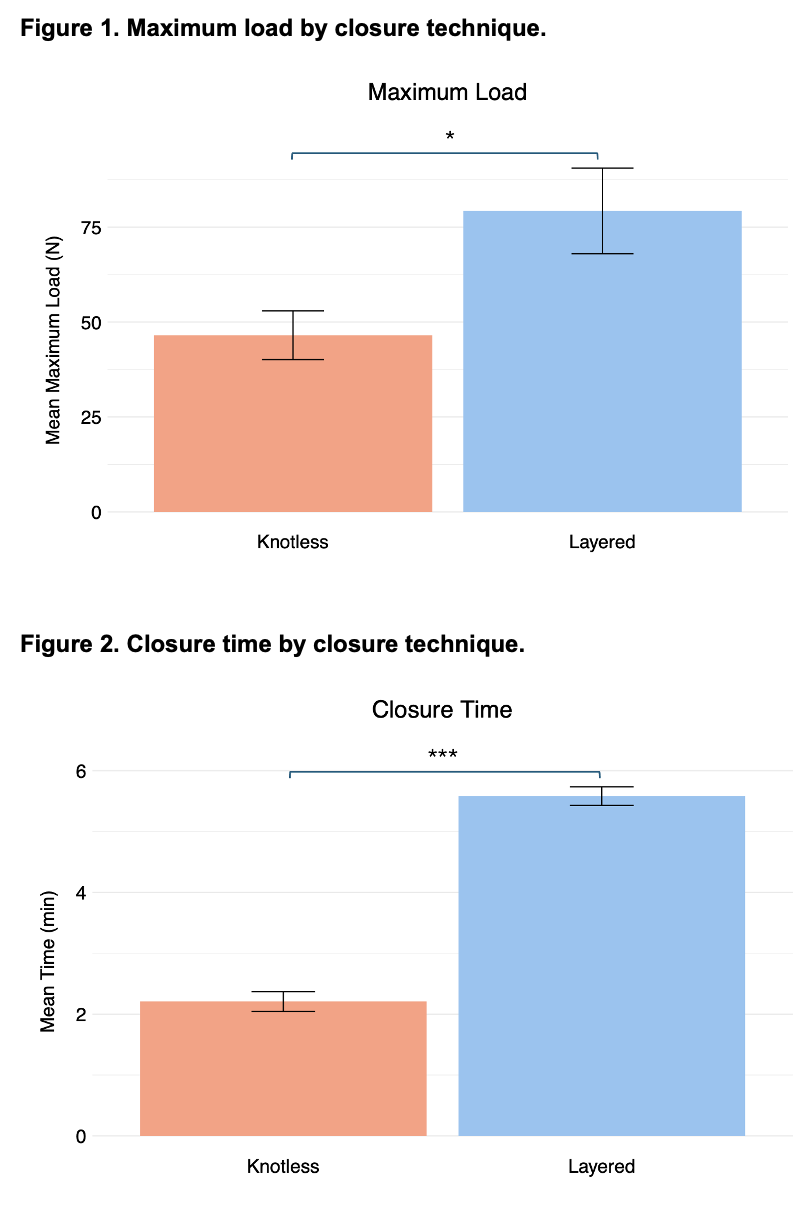
A single surgeon sutured the skin edges together with one assistant. Skin closure was timed. The sutured tissue specimens were clamped in a tensiometer using a side screw action tensile grip and placed under an initial tensile load of 0 N with an excursion rate of 40mm/min until the repair failed. The load to failure was measured in Newtons (N), and mode of failure was recorded.
All statistical analysis was performed in R (R Foundation for Statistical Computing, Vienna, Austria). P-values less than 0.05 were considered statistically significant. Shapiro-Wilk and Levene’s test were used to assess normality and homogeneity of variances, respectively, and these tests indicated that all data were normally distributed and had similar variances. The closure time and load to failure for each group were compared using t-tests.
Results/Complications:
Conclusion: