Defining Femininity: Crowdsourced Insights on Gendered Facial Features across Ethnicities
Methods/Technique: Four web-based survey instruments were used, displaying an image set of artificial intelligence-generated facial photos of a cis-man and a cis-woman from each of the following ethnicities - Black, Asian, Oceanic, South Asian, and White. Each survey evaluated the masculinity or femininity of specific facial components through various techniques to eliminate responder bias. Respondents voluntarily completed online consent forms and were randomly directed to one of the four survey instruments. Responses were de-identified to ensure anonymity. Faces were divided into 11 unique components, and were thus rated on a scale from 1 (most masculine) to 11 (most feminine).
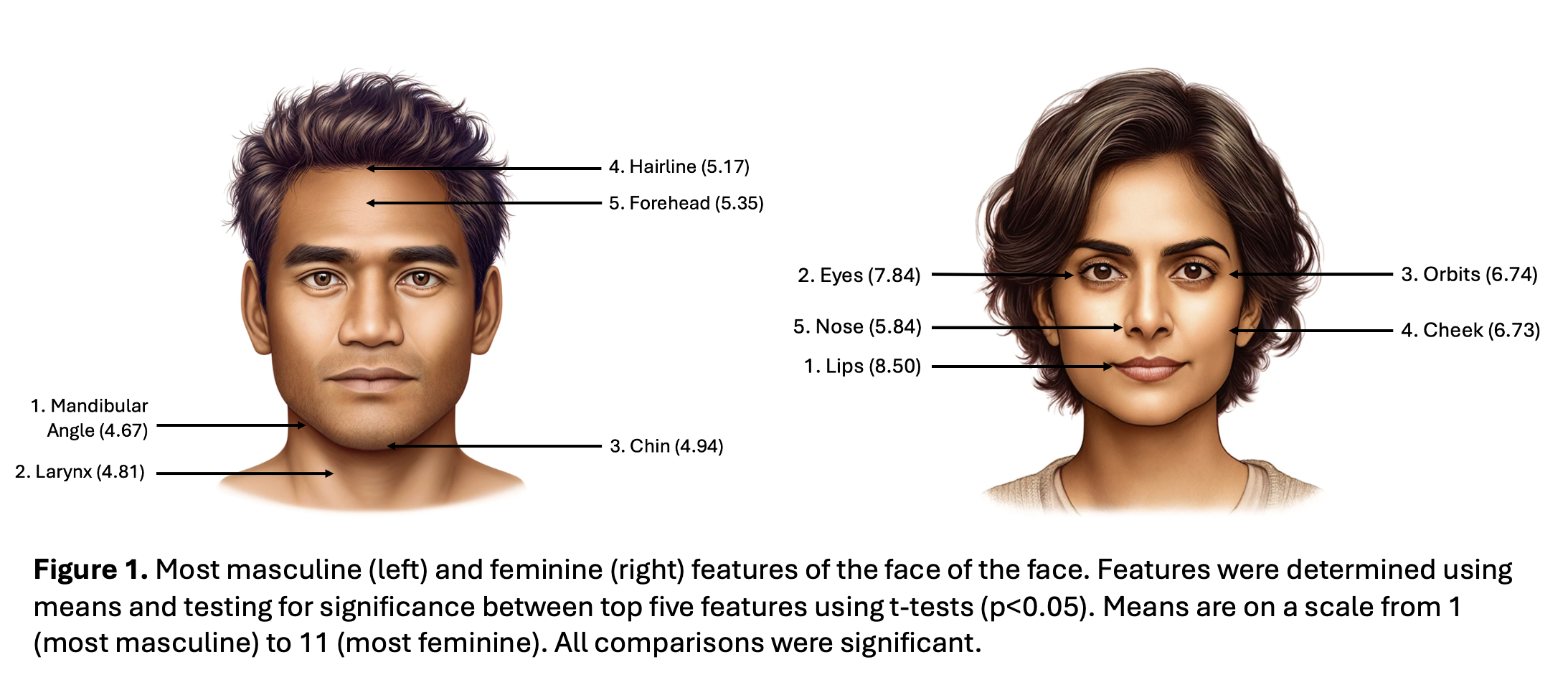
Results/Complications: A total of 2,566 respondents completed the survey instruments. There was no significant difference in the ethnicity, gender, or socioeconomic status of respondents across each of the survey instruments. Across all facial images, respondents identified the lips as the most feminine facial feature (7.98–9.41, p<0.0001). Male respondents rated the lips as the most feminine feature for all faces (8.03–9.32, p<0.0001), except for the face of the Oceanic female, where the eyes were rated as the most feminine feature (8.03, p<0.0001). Female respondents found the lips to be the most feminine feature of all faces except those of the Black female and White male, where the eyes were rated as most feminine (8.09, 8.20, p<0.0001). Overall, the most masculine facial features were the mandibular angle (4.67), laryngeal prominence (4.81), chin (4.94), hairline (5.17), and forehead (5.35), while the most feminine features were the lips (8.50), eyes (7.84), orbits (6.74), cheeks (6.73), and nose (5.84), which were all statistically significant (p<0.05).
Conclusion: This study provides valuable insight into the public’s perception of inherently masculine and feminine facial features across ethnicity and gender. Surgeons can use these findings to enhance patient satisfaction and use a patient-centric approach in the deliberation of a surgical plan.