Ultrasound Assistance for Deep Plane Face and Neck Lift
Seeking facial rejuvenation, improvements to the skin texture, sharper facial contour, volume restoration, and the preference for less invasive procedures with shorter downtime, the global incidence of cosmetic filler injections has significantly increased. While these procedures promise collagen stimulation and enhancement of facial volume, they may not provide the same efficacy in restoring youthful contours as surgical interventions. Furthermore, such procedures may potentially compromise the outcomes of future facelift surgeries, particularly when employing deep plane techniques that expose critical structures such as the facial nerve.
Additionally, patients often struggle to accurately recall or report the specific details of the procedures they have undergone, including the types and volumes of substances employed. Moreover, the long-term behavior of these agents within the various layers of tissue, as well as the complications that may arise, remain inadequately understood.
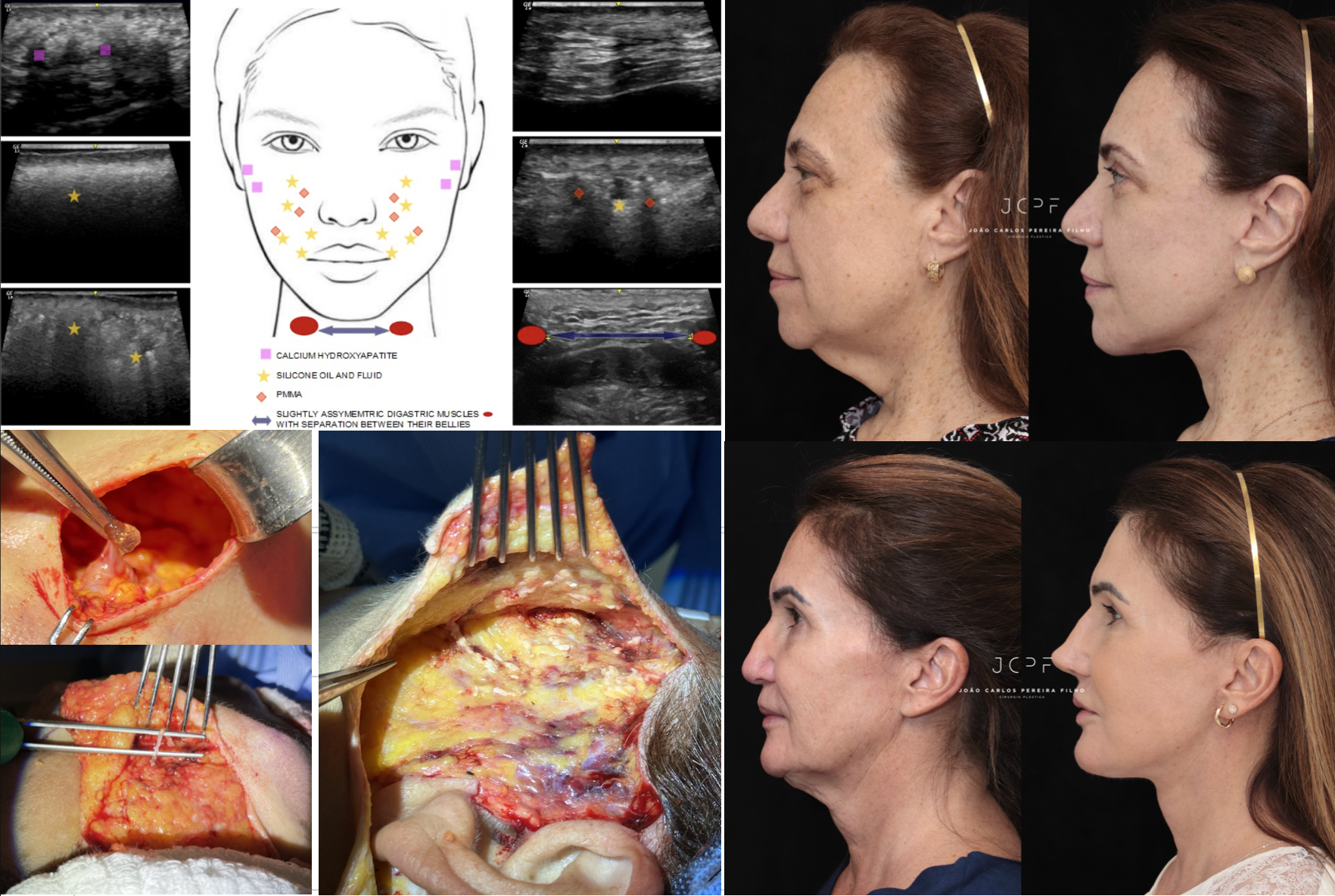
High-frequency ultrasound is a non-invasive, user-friendly, and reproducible technique employed to visualize subcutaneous structures. Given that facial fillers possess distinct characteristics and varying densities, ultrasound can be utilized to visualize these materials, thereby providing enhanced information regarding the aforementioned concerns.
The aim of this study was to evaluate cutaneous sonography for the detection and identification of cosmetic filler deposits, as well as to assess the correlation between the results and the patients' descriptions. Additionally, the study sought to provide detailed information regarding the anatomical locations involved in subcutaneous and deep plane face and neck lift dissection.
Methods/Technique
:A prospective study along 1 year was conducted involving 60 patients scheduled to undergo extended deep face and neck lift surgery to analyze their perceptions regarding injectable procedures they had done prior to their surgical intervention. Participants were queried about all prior procedures (Hyaluronic Acid - HA; Polymethyl methacrylate - PMMA; Calcium hydroxyapatite and Polylactic acid - Collagen Biostimulators; Threads; Other procedures), after that a high-frequency ultrasound was utilized to perform a facial and neck ultrasonography, aiming to identify the presence of these fillers. The study analyzed any discrepancies in patient responses, as well as the rates of complications (inflammatory; vascular; motor innervation) associated with the procedures performed. The findings and correlations between complications and products were subjected to statistical analysis by McNemar Test.
Results/Complications
:The cohort comprised 55 female participants and 5 male participants, with a mean age of 58.02 years (SD ± 8.03). Hyaluronic acid (HA) was reported by 44 patients (73.3%), while ultrasonography identified HA in 48 patients (80%). Polymethyl methacrylate (PMMA) was reported in 8 patients (13.3%), compared to 15 patients (25%) identified via ultrasonography. Collagen biostimulators were reported in 36 patients (60%) versus 32 patients (53.3%) found in ultrasonography. Thread procedures were reported by 25 patients (41.7%), while ultrasonography identified only 11 patients (18.3%) with these procedures. Other procedures were reported by 10 patients (16.7%), in contrast to 12 patients (20%) identified through ultrasonography.
The incidence of vascular complications was 7 patients (11.6%), all of whom had HA present. Inflammatory complications were observed in 21 patients (35%), with 20 of these cases also associated with HA. Motor innervation complications occurred in 8 patients (13.3%), all of whom also had HA present. P value < 0.001.
Conclusion
: This study concludes that patients often lack complete awareness of the total number of procedures they have undergone, as well as the specific products that were injected or placed in their faces. Furthermore, there is a direct relationship between the rate of complications and the presence of Hyaluronic acid.