TRAM Flap and Fat Grafting for Autologous Breast Augmentation
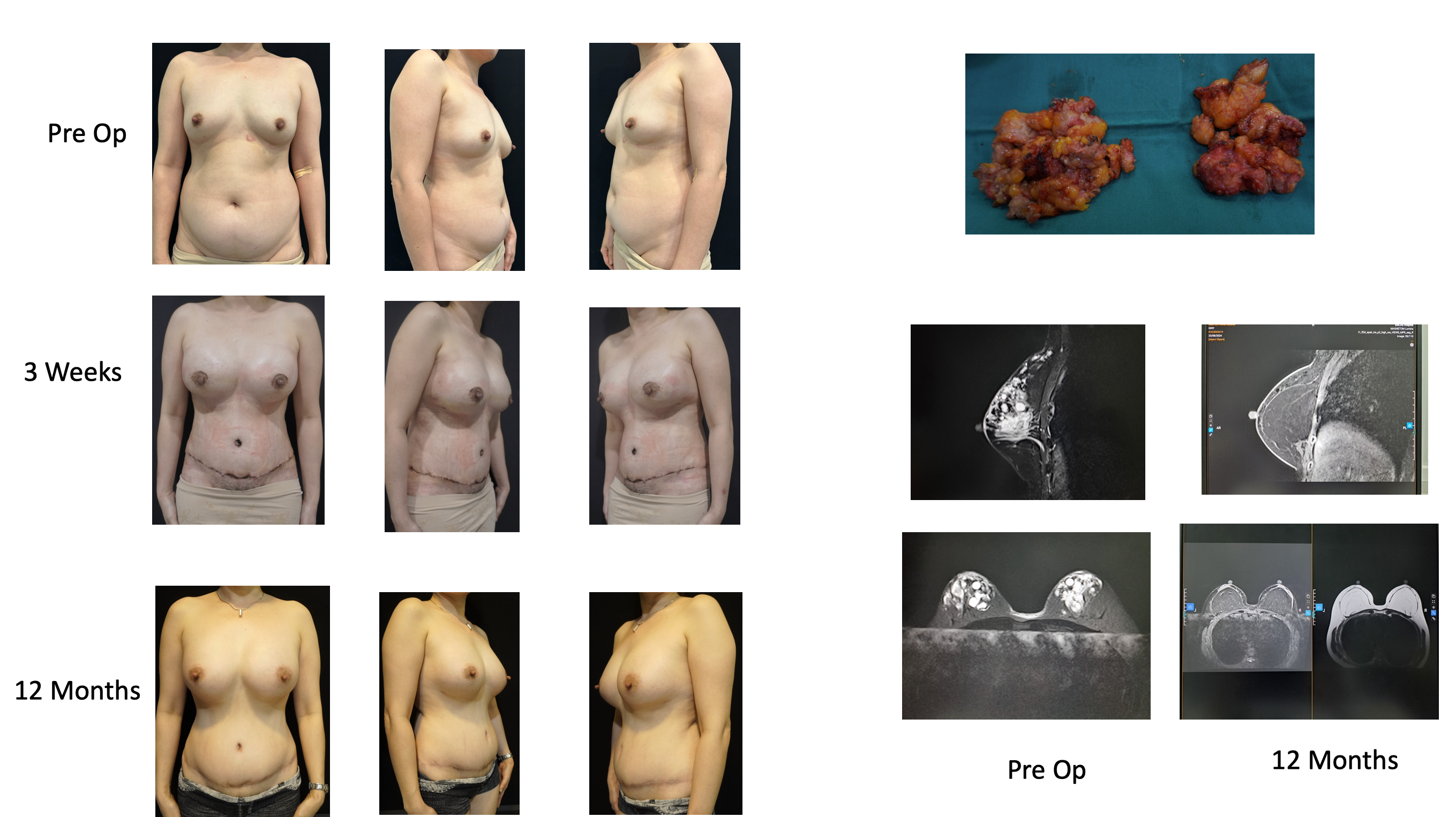
Methods/Technique: • Patient Selection : A prospective monocentric study was conducted on 55 women between June 2022 and Sept 2024. Patients in the following circumstances who prefer not to utilize implants, have no planned pregnancies, and desire to have abdominoplasty surgery for body-contouring: - Removal of an implant for a variety of reasons implant misplacement, seroma, capsular contracture, and implant visibility - Complication with injection of free liquid silicone - Breast hypotrophy / Mummy makeover • Surgical technique : A subglandular pocket was created. With its vascular pedicle intact, the deepithelialized transverse rectus abdominis (TRAM) flap was divided into two sections and mobilized off the abdominal wall. A tunnel is created in the medial inframammary fold. Flap is positioned in the breast pocket, it is tacked in place and further formed. The defect in the abdominal wall is closed. An interposition piece of mesh is necessary implanted to avoid future hernias. Liposuction was conducted in the hip waist , fat was grafted at the fat layer around both breast.
Results/Complications: A total of 55 cases met inclusion criteria. 40.20 is mean age , 47.1% breast contracture and rupture, awaited volume of lateral TRAM flap is 227cc, amount of fat grafting for each breast is 53.93cc. Following after surgery, no cases of complete or partial flap loss were clinically detected. There was no hernia or bulging issues, 01 case was infection. Patients were followed from 6 to 12 months, MRI 3Tesla was used to assess the survival of fat grafting and TRAM flap. Using BREAST -Q to assess the satisfy of all patients , 65.5% somewhat agree and 34.5% definetely agree with their expectation , 0 % disagree, sum score is 19.14, Equivalent RASCH Transformed Score is 64.47. Correlation between amount of fat grafting and satisfy of patient , R=0.288 , p= 0.33 and correlation between perfect size and surgery changed life with R= -0.375, p=0.005.
Conclusion: The initial success suggested the effectiveness and safety of autologous breast augmentation by using pedicled TRAM flap and fat grafting in the selective patients: breast implant removal, complication with injection of free liquid silicone and women with breast hypotrophy / mommy makeover