Composite Sling: A Strategy for Support in Mastopexy with Implan
Augmentation mastopexy is a prevalent plastic surgery procedure. Augmentation mastopexy utilizing the dual plane technique with a lateral sling is a method to enhance implant support and thereby sustain long-term results. This effective technique, pioneered by Ono and Karner, utilizes the abdominal part of the pectoralis major muscle to establish lateral sling support. However, in certain cases such as a short pectoralis major muscle or a short chest, this approach may not be viable. The composite sling presents itself as a solution to address this issue.This study outlines a technique that elongates and broadens the lateral sling, enhancing the lateral and inferior support of the implants as necessary.
Methods/Technique
:The composite sling technique was designed to address these challenges by lengthening and widening the lateral sling, thereby increasing inferolateral support. The abdominal portion of the PM originates from the anterior layer of the aponeurosis of the external oblique muscle, thus presenting a natural continuity with these structures. 7. Accordingly, we incorporate the aponeurotic portion of the external oblique, the cranial portion of the rectus abdominis muscle (lateral third), and sometimes the muscular part of the external oblique to customize the lateral sling.
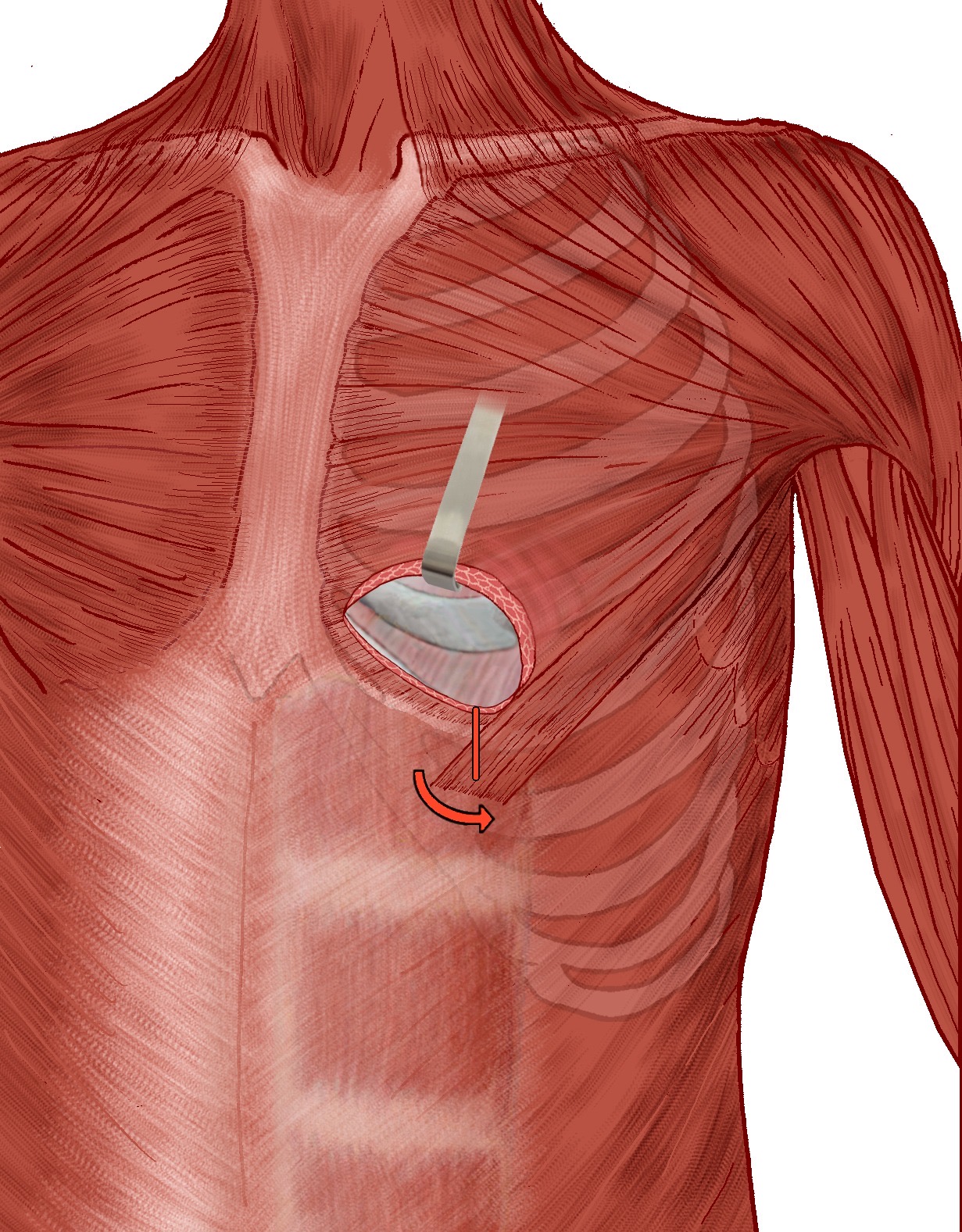
The submuscular pocket is created through a 3 cm incision at the level of the 5th intercostal space, medially to the hemiclavicular line. Through this incision, we perform atraumatic tissue dissection cranially, prioritizing prospective hemostasis. The lateral dissection of the pocket is limited laterally to approximately 1 or 2 cm from the anterior axillary line, preserving the abdominal portion of the PM. The costal origin of the PM (medial sling) is maintained to balance tension forces and prevent medial displacement of the implants. Internally within the pocket, the deep lamina of the PMis incised at this region and at the superomedial region to modulate muscle forces and prevent animation deformities. As shown in Figure 1 and Video 1. Additionally, the maintenance of the double sling prevents muscle retraction and rising, which could result in implant support loss, a challenging complication to treat. 8
Upon completion of pocket dissection, we proceed with of the composite sling through a vertical incision of the aponeurosis of the external oblique muscle at the midclavicular line near the 6th rib, followed by lateral dissection involving the relevant muscle and aponeurotic structures. This maneuver allows for precise and customized adjustment of the inferolateral sling, ensuring symmetrical support and implant positioning. Attempting to elongate or lengthen the pocket without using the described approach may cause accidental rupture of the abdominal portion of the pectoralis, leading to loss of inferolateral support. Therefore, the described tactic prevents detachment of the lateral sling.
The next step is to place the implants. If necessary, the composite sling can be adjusted to the lower edge of the implants with fixation stitches. The portion of the implants that is not submuscular is closed off by a fascia and glandular flap. The implants are inserted via IMF incisions in cases of primary augmentation mastopexy at the beginning of the surgery; the pocket is closed, and then the reduction of parenchyma and pexy are initiated. This tactic also includes aggressive glandular emptying to prevent the waterfall effect and improve breast definition. 9.
Results/Complications
:Between July 2022 and September 2023, a total of 29 patients underwent surgery utilizing the described approach. This method was employed in 23 (79,3%) cases of primary augmentation mastopexy and 6 (20,6%) cases of mastopexy with plane change (subglandular to submuscular). In 4 (13,7%) cases involving plane change, an expansion of PM was performed, as described by Hubaide.10 We used Silimed implants in 17(58,6%) cases, Impleo in 7(24,13%) cases and Motiva in 5 (17,24%). Patient ages ranged from 22 to 48 years, and implant sizes ranged from 210ml to 335ml. The use of the composite sling expands the range of indications for inferolateral support, as it allows its use even in cases where muscular or thoracic anatomy is unfavorable. Figures 2a and 2b show the results and evolution of a short chest who underwent mastopexy with a composite sling.
There was no observed increase in complications or implant displacements compared to the original lateral sling description. No reoperations were necessary due to issues related to the implant pocket. However, four (13,7%) reoperations were performed to address dog ears, scarring, and minor asymmetries. The maintenance of lateral support and the double sling support provides a good cleavage without the need for large implants.
Conclusion
:In conclusion, the composite sling technique represents a valuable tool in dual plane mastopexy with implants, especially in cases of unfavourable muscular or chest anatomy. By providing robust support, precise positioning, and implant stability, this technique contributes to high patient satisfaction. Mid-term follow-up demonstrates consistency and stability, particularly regarding upper pole fullness and prevention of lower pole ptosis (bottoming out), with no increase in complications rates.