Characterizing Facial Feminization Surgery Revisions and Complications in a Large and Diverse Cohort.
Facial feminization surgery (FFS) is an integral part of the gender-affirming care continuum, improving quality of life and physical and psychological well-being. Despite clear benefits, access to these procedures remains limited with only 7% of transgender women having had FFS. The intersection of race and insurance coverage plays a crucial role in determining access to gender-affirming surgeries and although facial feminization surgery is widely recognized as a medically necessary intervention, many insurance plans exclude it from coverage. Furthermore, the vast majority of FFS procedures in the United States have been performed on White patients. Accordingly, there is a lack of literature on FFS surgical characteristics and outcomes in diverse patient populations. Our institution previously showed that FFS performed on 17 patients at a public, safety-net hospital was associated with zero postoperative complications within 30 days and 3 revision procedures. In this study, we aim to specifically characterize the revisions and complications of FFS in a large, diverse cohort of patients to address the gaps in the current literature.
Methods/Technique:
A retrospective chart review identified patients who underwent FFS at the University of California, San Francisco (UCSF) between 2019 and 2023. Data on patient demographics, comorbidities, gender-affirming care history, surgical characteristics, and postoperative outcomes was collected via retrospective chart review from electronic health records. Statistical analyses were performed using R.
Results/Complications:
A total of 168 transgender women underwent FFS at UCSF between August 2019 to December 2023. The cohort had a median age of 39.8, with a range from 19 to 79 years old. The cohort was racially diverse, with 39.9% Hispanic, 30.4% White, 6.5% Asian, 6% Black, and 17.3% Other/Multiple/Unknown. There was also heterogeneity in insurance type, with 71.9% MediCal, 12% Medicare, 11.4% Private, and 4.8% Other/Unknown. The median BMI was 25.1 (IQR: 7.2).
The median total number of procedures per patient was 8 (IQR: 3); the most commonly performed procedures included brow lift (91.1%), rhinoplasty (76.8%), frontal sinus setback (74.4%), hairline advancement (68.5%), and mandibular contouring (67.3%). A total of 79.2% of patients had one stage of surgery, 18.5% had two stages, and 2.4% had 3 or more stages.
The overall rate of complications was 11.3%. Complications included infection (n = 10, 6%), return to the OR within 30 days (n = 6, 3.6%), hematoma (n = 4, 2.4%), emergency department visit (n = 4, 2.4%), dehiscence (n = 3, 1.8%), facial vein thrombosis (n = 1, 0.6%), respiratory event (n = 1, 0.6%), and other (n = 4, 2.4%).
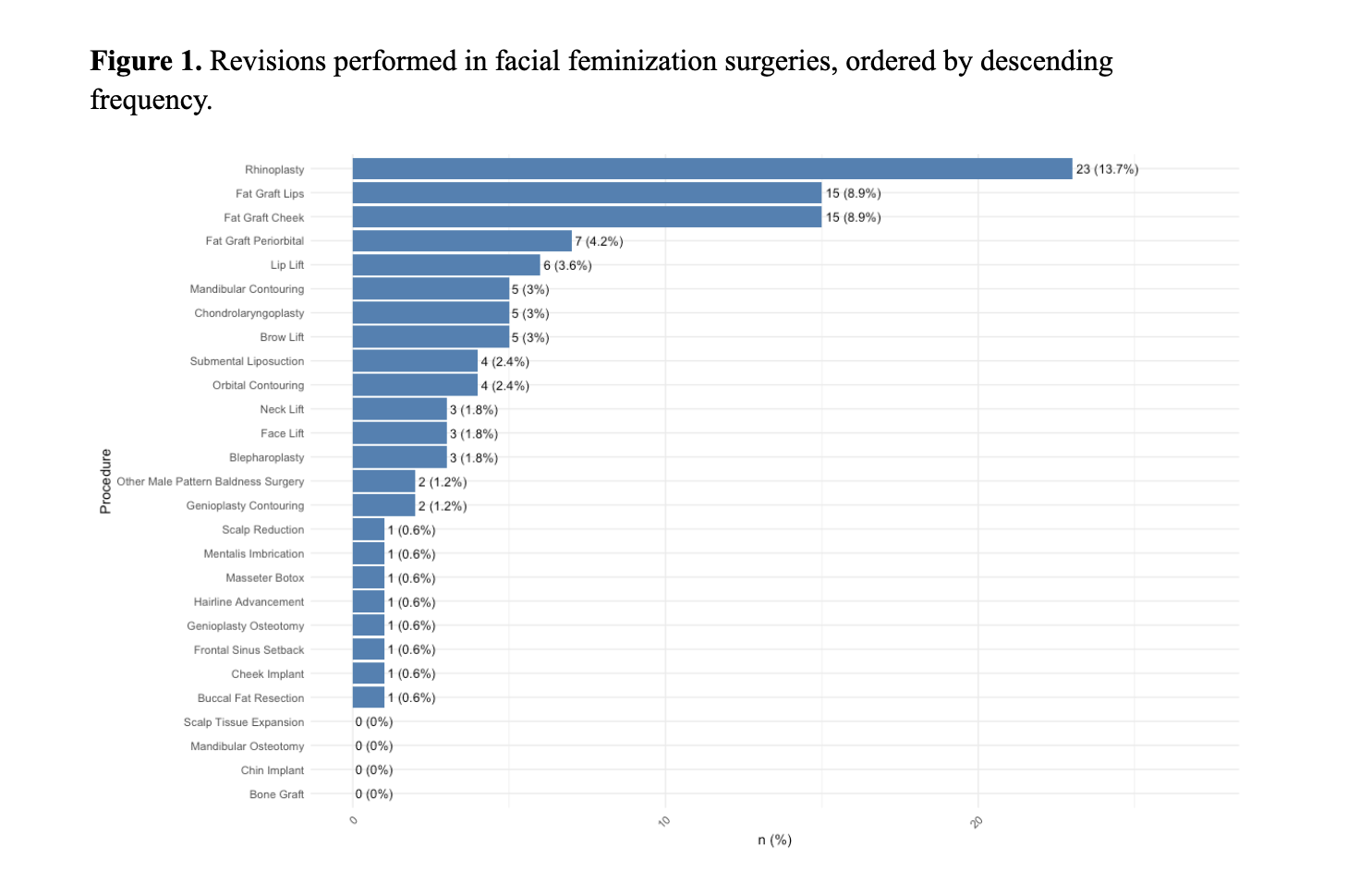
Ultimately, 22.6% of patients underwent one or more revision procedures; 14.9% had one revision, 6.0% had two, and 1.8% had three or more. Figure 1 presents the frequency of each of the 27 specific FFS revision procedures within the cohort, ordered by descending frequency. The most common revision procedures performed were rhinoplasty (13.7%) and fat grafting to the lips (8.9%) and cheeks (8.9%).
Finally, the relationship between the number of FFS stages (1 vs. ≥ 2) and the total number of procedures ( ≤ 8 vs. > 8) with complications and revisions was evaluated via logistic regression. There was no significant association between either predictor and either outcome.
Conclusion:
We characterized a wide variety of FFS specifications across 27 unique FFS procedures within a diverse cohort. Our findings demonstrate a relatively low rate of complications (11.3%), most of which were minor. Note that the facial vein thrombosis eventually resolved and the respiratory complication was nasal passage collapse that was subsequently revised. This is consistent with previous literature documenting FFS complication rates between 4 and 20%. We also found no association between the number of stages or procedures and complications or revisions. These findings affirm that FFS can be performed safely in patients across a wide variety of backgrounds, and with a wide variety of specifications.
In total, 22.6% of patients went on to have one or more revision surgeries. Rhinoplasty and fat grafting to the lips and cheeks were the most frequently performed revision procedures, consistent with literature supporting that rhinoplasty and fat grafting are two of the most frequently revised procedures within plastic surgery, in general. These data suggest that the revision rates may not be a function of FFS as a whole, but rather of the individual procedures within FFS that have individually high rates of revision.
In conclusion, we characterized FFS as safe and well-tolerated in a large, diverse cohort of patients, addressing key gaps in the current literature. We also identified notable trends in the specifications and outcomes of FFS and look forward to future efforts to bolster the growing evidence base for FFS and gender-affirming care.