Brachioplasty: A Modern Approach to Arm Aesthetics
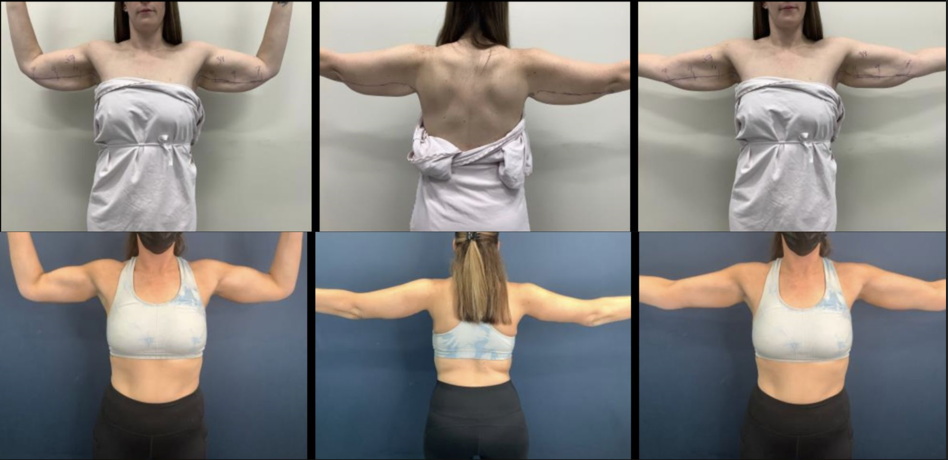
Arm aesthetics often receive insufficient attention in body rejuvenation. Loose arm skin represents the most noticeable and evident changes from aging and massive weight loss, however it is refractory to minimally invasive procedures such as radiofrequency micro-needling or laser treatments. Elite arm rejuvenation is much more than skin excision. Accentuating gentle contours and underlying muscle definition reveal the beautiful aesthetics of arm youthfulness and power.
Methods/Technique:
Surgical preparation markings are made with the patient standing starting from the ulnar groove between the olecranon and medial epicondyle. Anterior markings are placed at the most inferior portion of the arm while the skin is retracted posteriorly allowing for a gentle convex curve from the elbow to axilla. A Z-plasty pattern extends across the axilla, down the lateral chest wall as necessary for aesthetic sculpting. Posterior markings are made similarly with the skin retracted anteriorly with markings along the inferior arm. Patients are provided with oral pain medication and the soft tissue is infused with tumescent anesthesia. The patient is awake during the procedure to allow repositioning and muscle flexing. Following arm liposuction, skin is excised down to the fascial layer along the anterior markings with careful attention to the medial antebrachial cutaneous and ulnar nerves. Using multiple crossing marks with dart incisions allows for alignment of the tissue after excision and tensionless closure while still enabling the creation of soft contours along the arm. The tissue is temporarily closed with staples. At the axilla, maximum tissue excision is performed and insetting of the Z-plasty is used to prevent scar shortening and banding. Patient cooperation with frequent arm repositioning and muscle flexion allows for contouring at the bicipital groove and triceps while evaluating for skin turgor and tensionless wound closure.
Results/Complications:
A study of 49 patients undergoing brachioplasty with liposuction in a QUAD-A surgical facility from July 2020 to December 2023 were included. Predominantly women (96%) elected this procedure, with a mean age of 50.9 (34-75) and mean BMI of 29.96. Two males, mean age 50.6 (56-59) and mean BMI 26.67, underwent the procedure. Six patients had concurrent surgeries including neck lift with liposuction (n=2), bilateral breast reduction, back liposuction, trunk liposuction, and bilateral mastopexy with implant removal. One female patient presented 7 days post-operative with deep vein thrombosis (DVT) and pulmonary embolism. This patient also had 360-degree liposuction performed at the time of brachioplasty. Her post-operative work up revealed an Antithrombin III deficiency which had previously been undiagnosed. No nerve injuries were reported.
Conclusion:
Brachioplasty has evolved into an artform, beyond simply removing excess skin. Many historical obstacles to these goals can be overcome by performing refined techniques, including inferiorly placed preoperative markings, tumescent anesthesia, liposuction for contouring and pre-dissection, and dart incision for precise skin excision. Awake anesthesia allows patient assisted arm repositioning and muscle flexion during the procedure to evaluate contours and tissue turgor. These advances enable optimal arm aesthetics and contouring.