Comparative Outcomes of Smooth Versus Textured Breast Implants: A Pooled Analysis of 32,199 Implants
Capsular contracture is a well-known complication associated with breast implants, influencing aesthetic outcomes and patient satisfaction. Some studies have shown that textured breast implants tend to have a lower incidence of capsular contracture when compared to smooth implants, though recent studies have reported no statistically significant difference with some studies even reporting a lower incidence with smooth implants. Additionally, textured implants have been associated with a higher incidence of Breast Implant-Associated Anaplastic Large Cell Lymphoma (BIA-ALCL). Thus, the purpose of this meta-analysis is to provide a definitive and updated comprehensive comparison of smooth and textured implants by examining all reported complication rates and patient satisfaction from all primary studies comparing these implants. To our knowledge, this is the first meta-analysis to analyze both a comprehensive complication profile and patient satisfaction, including data from BREAST-Q scores.
Methods/Technique
:PRISMA guidelines were followed. Relevant studies comparing smooth and textured breast implants were identified through searching and screening the following databases: PubMed, Scopus, and Web of Science. Primary studies were included if they reported on complication rates or patient satisfaction for both smooth and textured implants. The primary outcomes included rates of capsular contracture, seroma, hematoma, infection, asymmetry, implant removal, rippling, rupture, and rotation. Secondary outcomes included patient satisfaction, measured using BREAST-Q scores. Statistical analysis was performed using R (version 4.2.1). Random-effects models were used due to expected inter-study variability. Statistical significance was set at p<0.05.
Results/Complications
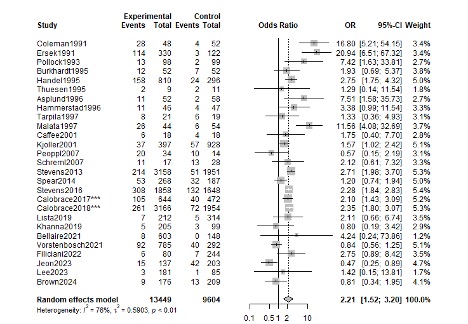
:The search yielded 1,387 studies, of which 32 were included in the meta-analysis. A total of 32,199 breast implants were analyzed (17,966 smooth and 14,233 textured). The analysis revealed that smooth implants were associated with significantly higher odds of capsular contracture (OR = 2.21, 95% CI = 1.52 to 3.20, p < 0.01). No statistically significant differences were observed in the rates of seroma, hematoma, infection, asymmetry, implant removal, rippling, rupture, rotation, and all BREAST-Q outcomes between smooth and textured breast implants.
Conclusion
:Our findings reveal a statistically significant association between smooth breast implants and a higher risk of capsular contracture, a complication impacting both aesthetics and patient satisfaction. Importantly, no significant differences were observed between smooth and textured breast implants for all other complications and patient satisfaction outcomes. These results suggest that while smooth implants may result in a slightly higher risk of capsular contracture, they should continue to be used over the recalled textured implants, particularly in light of textured implants' association with BIA-ALCL. Further longitudinal studies with longer follow up periods comparing smooth with microtextured and nanotextured implants are necessary to be able to conclude whether these newer implants result in a compromise between lower risk of capsular contracture without increasing risk of BIA-ALCL.