Breast Implant Shell Mechanical Properties: A Scoping Review
Breast implants are widely used in plastic and reconstructive surgery and are among the most studied medical devices. Understanding the mechanical properties of implant shells is crucial for optimizing performance, minimizing complications, and exploring systemic symptoms some patients report post-implantation. This review evaluates existing literature on the biomechanical properties of breast implant shells.
Methods/Technique
:Literature review was conducted across PubMed, Medline, and Web of Science according to PRISMA guidelines, for articles published between 2014 and 2024. Data extracted included implant type, rupture rate, compression strength, gel bleed, tensile strength, tensile stress, fatigue resistance, elasticity, texture, flexibility, and resistance to deformation. Analysis was performed using Microsoft Office Suite, 2024.
Results/Complications
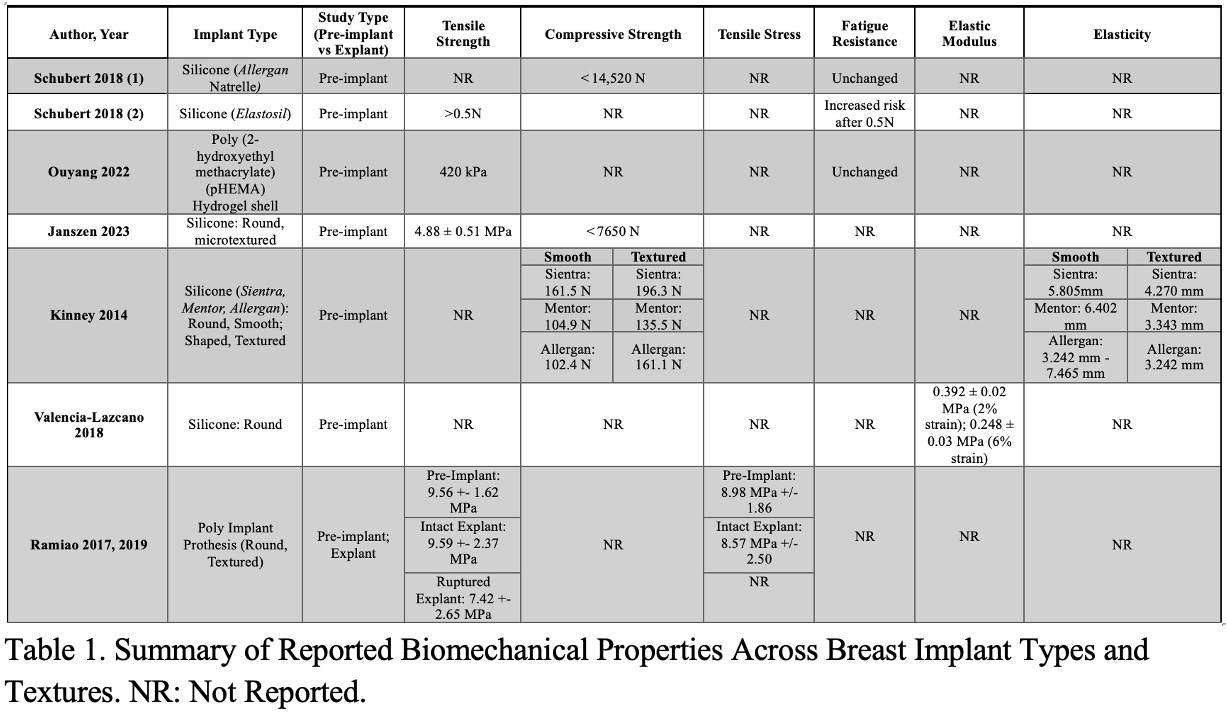
:Our search identified 263 publications, of which 14 met the inclusion criteria. Findings are summarized in Table 1. Across published data, there were significant variations in tensile strength. The shells of explanted ruptured implants were thinner with weaker tensile strength (0.73 ± 0.10 mm, 7.42 ± 2.65 MPa) compared to intact implants (0.91 ± 0.11 mm, 9.59 ± 2.37 MPa). Compression strength varied from 102.4 N to 14520 N, indicating varying resilience across different implant types. Resistance to deformation ranged from 40 to 80 kPa in pHEMA-based hydrogels, while different elastic moduli in silicone implants suggested potential differences related to implant material. In terms of elasticity, round implants had higher elasticity (5.8-7.46 mm) compared to shaped implants (3.24-4.27 mm). Texture analysis showed variation related to manufacturing techniques, with roughness measurements ranging from 0.06 µm (smooth implants) to 198.73 µm (textured using the salt-loss technique). The relevance of this range was underscored by fibroblast adhesion studies, which demonstrated that surface roughness between 14 µm and 21.94 µm promoted increasing cell adhesion and spreading, which may be relevant in cases of capsular contracture. Additionally, one study noted that irradiation did not alter the mechanical or microstructural properties of textured silicone implants. No studies reported rate on implant surface friction, flexibility, or rate of rupture.
Conclusion
:Understanding the mechanical properties of breast implants is essential for predicting and optimizing surgical outcomes. Our review suggests that tensile strength may be correlated with implant rupture, while roughness may be relevant to capsular contracture. Gel-shell adherence may be another parameter warranting future study in order to predict implant longevity. Further research evaluating implant mechanical properties may help assess the influence these factors have on shell integrity, stability, and patient comfort after breast augmentation and reconstruction.