Rhinoplasty Outcomes in Patients Undergoing Gender Affirming Surgery: A Single-Institutional Experience
Methods/Technique: Retrospective review was conducted on all TGD patients undergoing facial feminization surgeries at a large academic institution. Variables of interest included patient demographics, comorbidities, primary or revision rhinoplasty, graft types (spreader, septal extension, alar rim, columellar strut, lateral crural strut), need for dorsal augmentation, and need for alar base and/or sill resection. Primary outcomes of interest included postoperative surgical and medical complications. Postoperative surgical complications included keloid or hypertrophic scar, difficulty breathing, altered sense of smell, septal deviation, septal perforation, septal hematoma, infections and/or erythema requiring oral and/or intravenous antibiotics, warping and/or resorption, and postoperative steroid injection requirements. All patients had a minimum of 6-month follow-up. Standard statistical analysis was performed with significance set to p < 0.05.
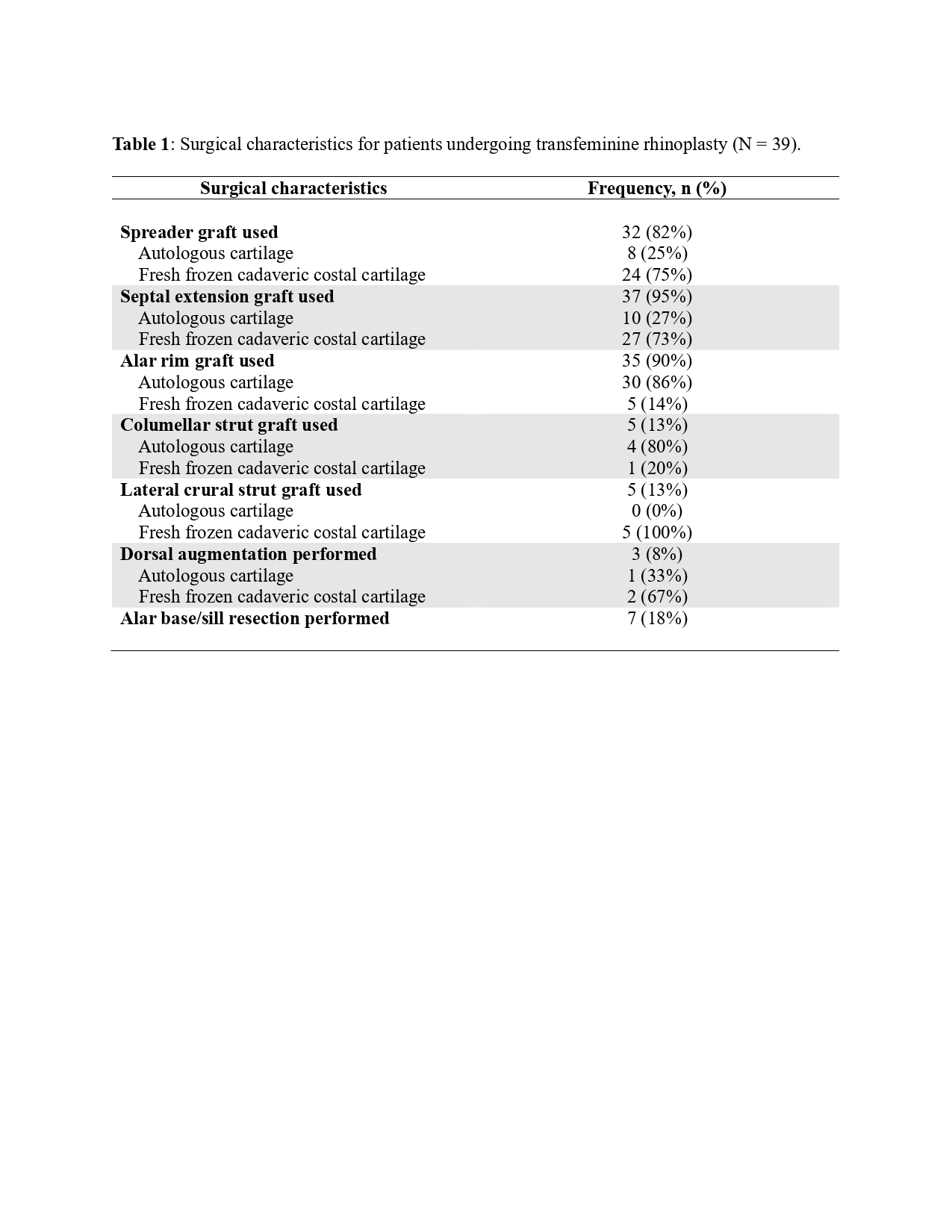
Results/Complications: Between January 2020 and March 2024, 39 patients underwent rhinoplasty procedures. Of these 39 patients, 33 (85%) underwent primary rhinoplasty and 6 (15%) underwent revision rhinoplasty procedures. The mean age was 33 ± 10 years and mean body mass index was 26 ± 4.8 kg/m2. No significant medical comorbidities were noted in this cohort. Data regarding surgical characteristics in transfeminine rhinoplasty is available in Table 1. The most common graft types included septal extension grafts (95%), alar rim grafts (90%), and spreader grafts (82%). Grafts were composed of either autologous septal cartilage or fresh frozen cadaveric costal cartilage. Autologous cartilage was most frequently used for alar rim grafts and columellar strut grafts (86% and 80%, respectively), while fresh frozen cadaveric costal cartilage was most frequently used for spreader grafts, septal extension grafts, and lateral crural strut grafts (75%, 73%, and 100%, respectively). Overall, there were no major functional complications or medical complications; there were very low rates of minor complications, most notably two patients (5%) experiencing hypertrophic scarring and five patients (13%) requiring post-operative steroid injections for edema and/or scarring.
Conclusion: Transfeminine rhinoplasty is a common facial feminization procedure and is overall safe with low complication rates. Transfeminine patients desiring rhinoplasty should be counseled on the high likelihood of grafting requirements for this procedure, risk of scarring, and the potential need for postoperative steroid injections.