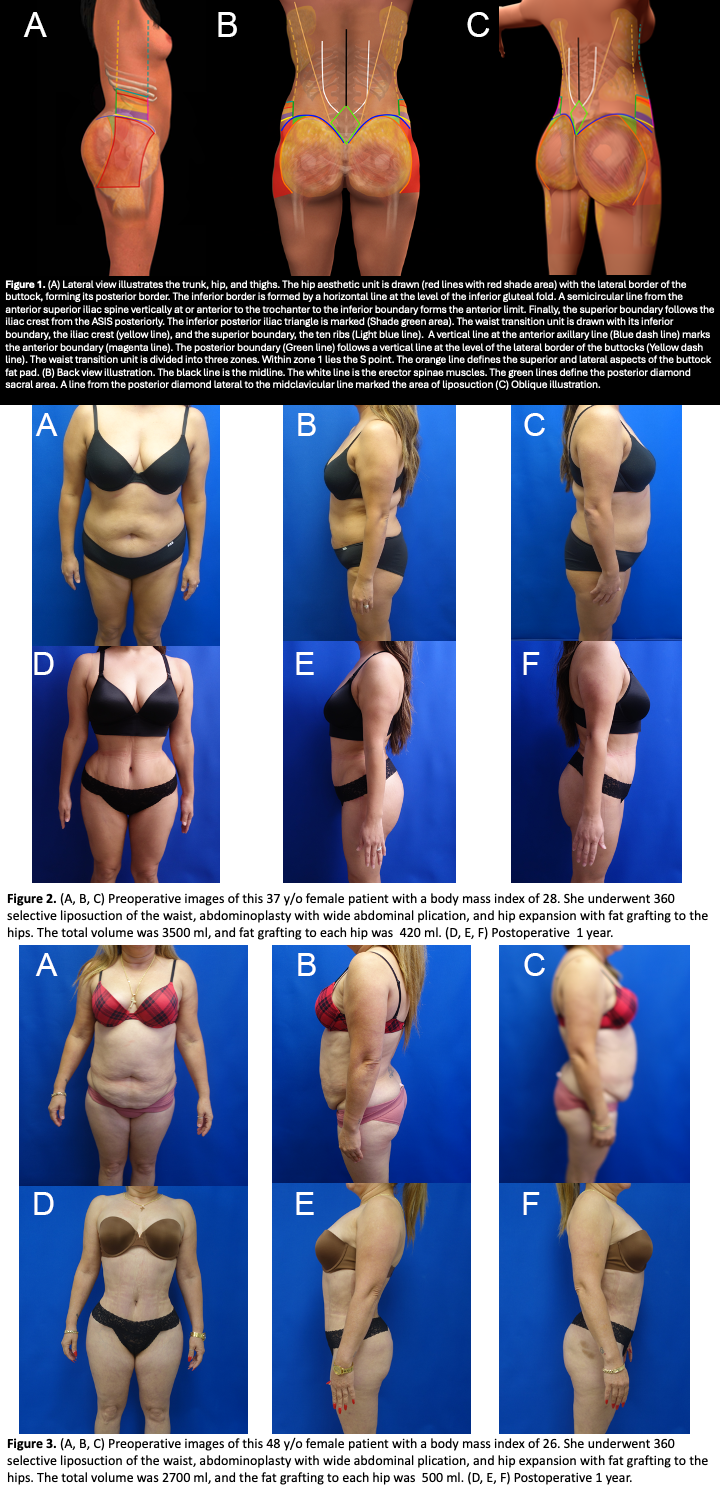
Defining the Zones of Selective Liposuction 360 to Improve the Female Silhouette.
One of the components for achieving a smaller waist is improving the waist-to-hip ratio through liposuction. Waist shapes can vary, with fat distributed in different areas, and several factors can affect the final results. It is, therefore, essential to carefully evaluate the waist transition aesthetic unit's surface anatomy. This unit has specific boundaries, natural curves, and different zones that must be addressed gradually to create a balanced and attractive female silhouette. The authors share their waistline contouring technique, with liposuction as the first step in achieving the desired results. These include:
- The "S point" is located at zone 1 or between zones 1 and 2, where the waist is at its smallest horizontal dimension and the waist begins. Liposuction should be performed more aggressively in this area, aiming for a pinch thickness of 1 cm or less.
- Progressive liposuction in zone 2 to a pinch test of 2 cm and into zone 3 to a pinch test of approximately 3 cm to avoid unnatural step-off deformity as the waist transition aesthetic unit blends with the iliac crest and the hip aesthetic unit distally.
- Debulking the posterior inferior iliac crest triangle defines the waist posteriorly as it blends with the hip and the buttock aesthetic units.
Methods/Technique: The medical records and insurance claims of patients who underwent selective liposuction for waistline contour in addition to various procedures including abdominoplasty, gluteal augmentation with or without implants, or liposuction alone with hip expansion to improve the female silhouette from November 1, 2016, to November 1, 2023, were analyzed. Photos documenting progress were taken prior to the procedure and during follow-up visits at one, three, six, and eight months, and, if possible, after one year.
Results/Complications: A total of 1,835 consecutive cases were identified. The average age was 36 (maximum 68 years, minimum 18 years). Average body mass index (BMI) was 29 (maximum 45, minimum: 18). The complications encountered were: hematoma (3, 0.2%), pulmonary embolus or deep vein thrombosis (3, 0.2%), symptomatic anemia requiring transfusion (3, 0.2%), surgical site infection (25, 1.4%), delayed wound healing or abnormal scarring (91, 5.0%), urinary retention (7, 0.4%), seroma (5, 0.3%), and other medical complications (24, 1.3%). Four (0.2%) patients required excision of skin in the waist area secondary to injury to the subdermal plexus.
Conclusion: Improving the waist with liposuction provides a safe and reliable technique that improves patient surgical outcomes. A thorough preoperative assessment focused on the zones of the waist transition aesthetic unit is essential for achieving satisfactory results. Addressing the waist transition aesthetic unit systematically is crucial for improving the waist-to-hip ratio and avoiding complications, such as step-off deformities at the superior aspect of the iliac crest, unnatural transitions where it blends with the hip aesthetic unit anteriorly, and violations of the buttock aesthetic unit posteriorly.