Shifting Aesthetics: Trends in Facial Proportions and Attractiveness over the Past Decade
Methods/Technique: We used TC Candler’s “Annual Independent Critics List of the 100 Most Handsome Faces” which features the top 100 men from over 40 countries, spanning the years 2013 to 2023. The images selected for analysis were sourced from Getty Images and adhered to strict inclusion criteria: a frontal profile, absence of glasses, a visible hairline, and minimal facial animation. Each image was processed through Dlib, a widely used facial recognition software, to identify eleven facial landmarks, with a twelfth point added manually to mark the forehead. Using Python, we calculated the distance between each of the landmarks in pixel coordinates. Using Excel, we calculated nine vertical and six horizontal proportions, and one aspect ratio. Additionally, we calculated average annual ratios for all winners of each year, allowing for a composite overview of trends over time. Changes in average ratios were analyzed using linear regression techniques, with slopes and R² values calculated for key ratios to assess the statistical significance of observed trends through F-tests.
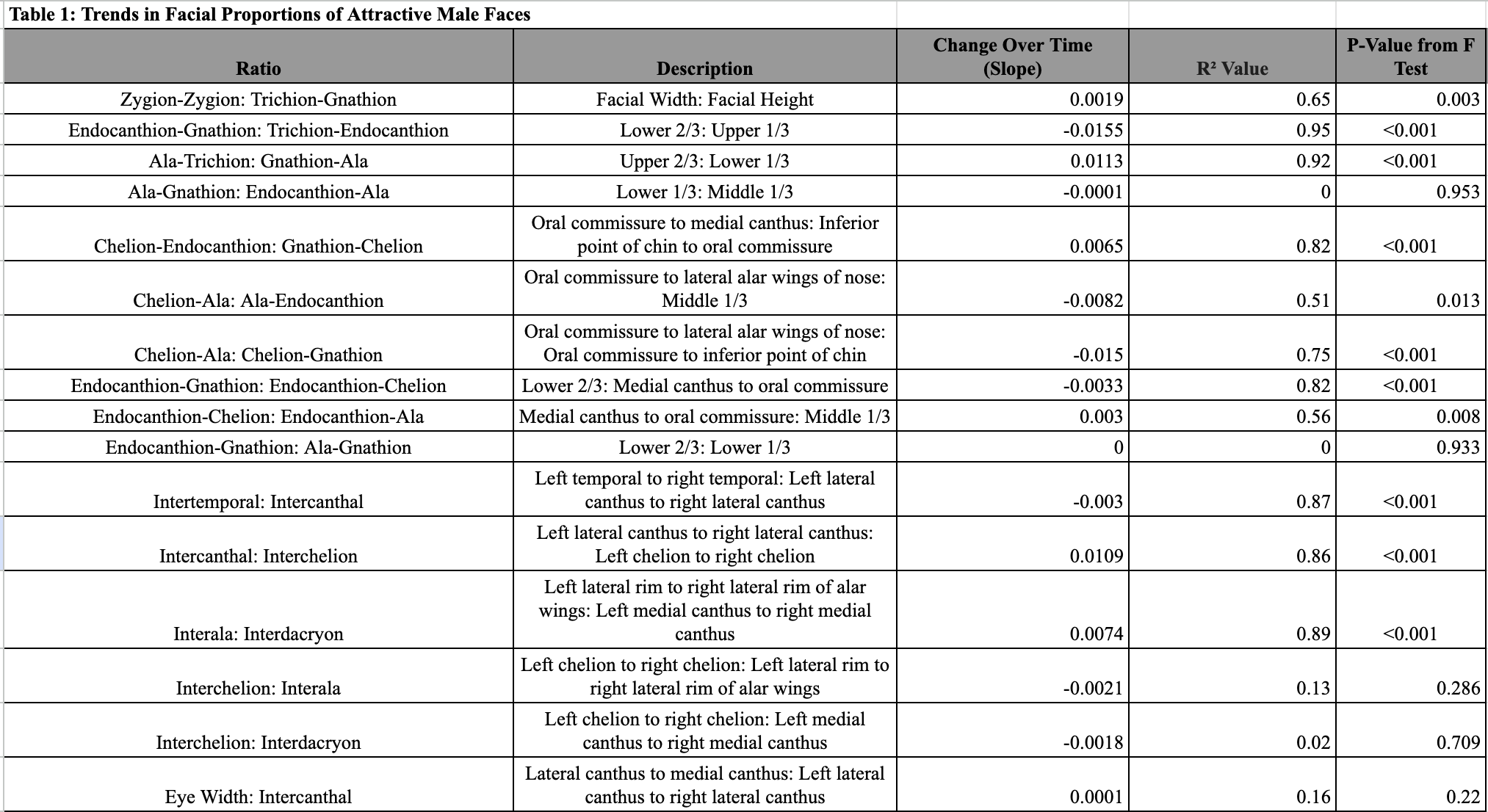
Results/Complications: The analysis revealed strong, significant trends in several facial ratios, indicating stable patterns in certain dimensions. We found that eight of the sixteen ratios decreased over time, but only five showed statistical significance. Significant shifts were observed in most ratios, with notably high R² values for Endocanthion-Gnathion: Trichion-Endocanthion (R² = 0.95, p<0.001), Ala-Trichion: Gnathion-Ala (R² = 0.92, p < 0.001), and Interala:Interdacryon (R² = 0.89, p <0.001), indicating consistent trends in these proportional relationships. Four ratios showed significant increases over time: Ala-Trichion: Gnathion-Ala (R = 0.92, p < 0.001), Chelion-Endocanthion: Gnathion-Chelion (R = 0.82, p< 0.001), Intercanthal: Interchelion (R = 0.86, p < 0.001), and Interala: Interdacryon (R = 0.89, p< 0.001). In contrast, ratios such as Ala-Gnathion: Endocanthion-Ala and Endocanthion-Gnathion: Ala-Gnathion, and Interchelion: Interdacryon exhibited low R² values and non-significant p-values, indicating limited or no consistent trends.
Conclusion: These findings have potential implications in the field of facial plastic surgery, where tracking changes in facial proportions over time can inform procedures that aim to enhance harmony and natural balance. High-correlation ratios that show significant change may help surgeons understand evolving aesthetic standards, while stable areas indicate where variations may be less impactful. By documenting these evolving trends in facial proportions, our study provides valuable insights into contemporary aesthetic ideals, equipping facial plastic surgeons with data to refine their techniques and meet patient expectations for a more balanced, modern appearance. This information provides insights that can help guide personalized surgical approaches for achieving natural, balanced aesthetics based on contemporary proportional trends.